Showing posts with label Effects of GMOs. Show all posts

Monday, August 19, 2013

Everyone Needs a Treat

Need a treat?
 
  Going too long without a treat is impossible. And I doubt I am alone in thinking that way. For me, never indulging in a cookie or two, ice cream, or crackers or chips is not an option.

  I've found an all or nothing mentality doesn't work too well. I need balance and routine. Even in my eating habits.

  As careful, and as conscientious as I am about how I eat, I always find room for an occasional treat or two! I'd go crazy otherwise.

  Giving yourself a break, indulging -- whatever you want to call it -- is a necessity in order to stay with your day-to-day routine. Long term dieting, if that's what you wish to call it, isn't possible.

No Chemicals, Please
  How you indulge, and how often you indulge is key. When it comes time for your treat, be picky!

  Calories and fat are okay. Chemicals are not! I know, in today's world, this is tough. The readily-available stuff -- the candy bars, the potato chips, the microwave popcorn -- is the easiest to get our hands on! But it's also the most damaging health wise.

  Not surprisingly, there are non-chemical options. You just have to look a little harder to find them.

Unreal comparison.
  For those with a sweet tooth (like me), check out Unreal Candy. They 'reinvente' your favorite candy, and make it with 100% REAL ingredients. No artificial junk, no corn syrup, no hydrogenated oil, no preservatives, no GMOs, and 50% less sugar.

  Cleaned up junk food. Worth a try if you ask me.

  If you find yourself reaching for a candy bar, make it an Unreal candy bar. Or there's Newman's Own Organics cookies. Or Eden Organic popcorn.

  The point is: there are options. And they go beyond M&Ms, Ritz Crackers, Doritos, and Orville Redenbacher's Popcorn. They are non-GMO, no chemical foods.

  Our body knows how to process calories, fats, and sugars. It doesn't, on the other hand, know what to do with chemicals. When we take the chemicals out of our snacks, it then becomes about the quantity -- how much we're eating of it (check out the podcast linked below for Jillian Michaels' talk of her 80/20% rule).

  Long story, short: pick a version of  your treat of choice that is not loaded with chemicals and/or trans-fat.

 Many times, this conversation leads to diet talk: the fad diet everyone is trying at the moment, what's working for your friend, and so on. Everyone wants to know, 'what should I be doing; what's the best diet?' 

Fill up with whole foods.
The Best Diet
  There is no 'best diet' per se.

  What I find valuable about each diet-of-the-moment is that they allow me to learn a little bit more about nutrition. If you do some research on your own, and try to learn about the various (and they are wide-ranging) ways of eating, you'll find yourself becoming educated on each and every one of them.

  You learn about food, and how it fuels you. You learn what works for you, and how your body reacts to various foods. We're all vastly different, and therefore we all react to eating habits and diets in different ways. You learn to value the quality of food.

  And most importantly, at least for me, it truly allows you to realize a balanced diet, filled with as many 'whole foods' as you can fit in, is the way to go.

  Check out this blog post from Precision Nutrition for great information about diet specifics.

  It's realizing it's a lifestyle choice, not a diet. Being healthy isn't a destination, it's a way to live.

Fads Come and Go
  Diets, gimmicks, and the popular workout-of-the-year don't last forever.

  Excluding entire food groups (such as fruit), one macronutrient or another (carbohydrates, for example), or strict demands with how to prepare food (raw food diet) are impossible diets to stick with for a prolonged period of time, let alone your entire life.

A little joke I dug up.
  To restrict yourself in such an extreme way is not a sustainable way of life.

  While you might go low-carb or paleo for four or five months, and see great results. Inevitably, we start going back to a more 'normal' way to eat. Those restricted foods are added back in, and that's when we run into trouble.

  The basics -- the well-rounded, whole food, in-moderation advices -- will last through time. If 'healthy' is a goal, habits and lifestyles have to be adjusted to match that goal. Again, it's a lifestyle, not a diet.

  We've all heard it, and it's true: Cleaning up your diet, limited processed foods, really will make you feel better, and be healthier -- even when you find yourself wandering towards the junk food aisle!

  Be conscientious and thoughtful about how you are eating, but don't forget to give yourself a break every once in a while too! It will make you more successful in the long run.

LINKS:

Tuesday, February 12, 2013

Follow Up: Banned Ingredients Remain in the US Food Supply


  I came across an article this morning that touched on a topic I wrote about last week: food companies removing GMOs from products distributed in Europe, but leaving them in the same products sold in the US.

  Only this article is much-more detailed, and covers, not only GMOs, but also a whole list of ingredients that are banned around the globe, but remain in the American food supply.

  Please read the in-depth article by Vani Hari via 100 Days of Real Food. If you're like me, you'll find yourself deeply disturbed, upset, and searching for things to do.

  Once you've read the article, pass it along to friends and family! We cannot allow these practices to continue. Look what is at stake!

  Thanks,


LINKS:

RELATED POSTS:

Friday, February 8, 2013

M&M Analysis: Altered Recipes in Europe Remove GMOs

The two wrappers.

  I had a brilliant idea for a blog. At least I thought I did. It was a little exploratory project I thought would be interesting.

  I had two empty wrappers of Peanut M&Ms: one from Europe, and one from the US.

  I'd previously read articles about how food companies such as Kraft, Kellogg's, Heinz, Coca-Cola and Pepsi have altered recipes, and removed GMO ingredients, for distribution in Europe. So I wanted to see that practice in action.

  Obviously, these two wrappers would illustrate those changes, right? I simply had to translate and compare the ingredient lists from each wrapper.

  As it turned out, there was nothing glaringly different! I was bummed, and thought my project was a failure.

  Then the light bulb went on: there weren't any differences on the labels because the US still does not require genetically modified foods to be labeled (while countries in the European Union do)!

The ingredient list: basically the same. Or so it seems.
Different Label Requirements
  In the US, genetically modified sugar or canola oil, for example, is listed simply as 'sugar' and 'canola oil'.

  In countries where GMO labeling is required, the ingredient list says 'genetically modified sugar' or 'genetically modified canola oil'.

  In France, where I got the 'Euro-edition' wrapper, GMOs are required to be labeled. So the question is: why weren't the ingredients listed on my two Peanut M&M wrappers different?

Changing Recipes and Removing GMOs
  Well, that's simple. Because the candy company, Mars in this case, has altered its recipe and has taken out the genetically modified ingredients for European distribution. They want to avoid having the GMO label on their product, so they adjust.

  So they can do it! They just choose not to for their American consumers! To be honest, I find the practice extremely disturbing.

  Together Hershey's and Mars make up 70% of the US chocolate market, and spent $1.1 million combined to defeat California Right To Know (Proposition 37) last election. They would rather spend money to oppose labeling, than listen to the demands of US consumers and label GMOs.

  My goal isn't to take away your joy, and ruin your candy experience. I love Peanut M&Ms just as much as the next person. I just want to show that the food companies can make the same products without putting genetically modified ingredients in them.

"There's nothing sweet about GMOs".
Nothing Sweet About GMOs 
  They're not going to make any changes on their own however. They need a push. And it seems it needs to be a big push.

  We, as consumers, need to keep providing that push, and ask that genetically modified ingredients be removed from our food, just as it has been done in Europe.

  The push comes in the form of the 'there's nothing sweet about GMOs' campaign. It's simply asking Hershey's and Mars to break their ties with GMOs, and to remove them from products offered in the US.

Why no GMOs?
  I have previously written several posts (links listed below) that go into greater detail, but first and foremost: consumption of GMOs have never been proven safe. They have never been tested long term, and we are just now witnessing the potential health hazards that GM foods have on our health: spikes in infertility, obesity, Diabetes, Autism, Parkinson's, asthma, cancer, etc rates since GMOs' wide-spread introduction in the US in the late-1990s.

  There are environmental impacts as well: biodiversity loss, an increase in pesticide use, the emergence of super weeds that are threatening our farmlands, and the unintentional contamination of non-GMO and organic crops.

  And if you're curious, here are 10 GMO Ingredients in Candy:
  1. Sugar (GMO Sugar Beets)
  2. High Fructose Corn Syrup (GMO Corn)
  3. Corn Starch (GMO Corn)
  4. Soy Lecithin (GMO Soy)
  5. Soybean Oil (GMO Soy)
  6. Modified Food Starch (GMO Corn)
  7. Fructose, Dextrose, Glucose (GMO Corn)
  8. Cottonseed Oil (GMO Cotton)
  9. Canola Oil (GMO Canola)
  10. “Other” Ingredients (Isolates, Isoflavones, Food Starch, Vegetable Oil)
  I suppose my failed blog idea wasn't such a failure after all. Candy is just one small example of international companies changing their product to reflect the demands of their consumers; in Europe. It's done in many other products including soda, cereal, and other packaged foods.

  Here's my question: why can't American consumers enjoy the same 'luxuries' as European consumers?
 
RELATED POSTS:
Do You Know What GMOs Are? 
The Dangers of GMOs
The Harmful Effects of Soy
GMOs: What Can We Do?
California's Prop 37

LINKS: 
There's Nothing Sweet About GMOs Campaign
Going GM-Free. In Europe, But Not the US
Altered Recipes & Risks Associated with GMOs
GM Ingredients in Candy
Labeling Requirements: Europe
California Right to Know

Thursday, January 10, 2013

Organic vs. Conventional: Which is 'Healthier'?

So many options in the produce section these days.

  'Is Organic Food a Hoax?'

  I've seen this headline, and others like it, far too many times the past few months. And frankly, they have me irked. I find them misleading and irresponsible.

  A Stanford study, released early-September of 2012, claims to have found "little evidence of health benefits from organic foods" and that, organic foods are 'no healthier' than conventional (chemical) foods. The report spurred an influx of question marks hurled at the organic food industry.

  Almost immediately after the report was released, news reports, articles, blogs, you name it, questioned whether organics were worth the expense, and sported headlines stating organics were no healthier or 'better for you' than conventional products.

  Sadly, they've missed the point.

The Study
  Stanford University researchers conducted the "most comprehensive meta-analysis (review) to date of existing studies comparing organic and conventional foods." After analyzing the data, the researchers found "little significant difference in health benefits between organic and conventional foods."

  No "consistent differences" were found between vitamin content of organic and conventional products. Only one nutrient, phosphorus, was significantly higher in organic products.

  No difference in protein or fat content between organic and conventional milk were found, among other results.

  Alas the statement, "organic foods are no healthier than conventional food".

  Honestly, the findings are not surprising. Call me crazy, but the organic industry has never claimed its food to be more nutrient dense, or 'healthier' than conventional foods. 

What Does Healthier Mean to You?
  If 'healthier', to you, refers ONLY to nutritional content -- how many calories, grams of vitamin C, protein, fat, or carbohydrate a product has -- then of course, organic and conventional foods are not much different.

  The Stanford researchers narrowly defined 'health' solely based on those terms.

  The premise behind organic is NOT that they any MORE nutritious. It's what you're avoiding: the CHEMICALS, HORMONES, and ANTIBIOTICS that come with conventional foods.

Organic or conventional???
Real Findings
  Buried in the report was this small statement, however: "though consumption of organic foods can reduce the risk of pesticide exposure." THAT has been the claim, and will always be the claim of organic foods.

  It's not what you will GAIN from eating them, but what you will AVOID.

  Aside from the attention-grabbing headlines, these were the ACTUAL findings of the study:
  • Organic foods were just as nutritious as conventional foods.
  • Conventional produce were more likely to carry pesticide residues.
  • Organic milk contained more heart-healthy omega-3 fatty acids.
  • Conventional meat was more likely to be contaminated with antibiotic-resistant bacteria.
Conflicting Studies
  Nutrition research on organic foods are still in their beginnings. There have not been many studies conducted, and there are numerous variables that can have one affect or another on nutrient content. Ripeness of a piece of fruit, for example, directly affects nutritional value.

  Findings from another recent study, at Washington State, directly opposes the Stanford report. When comparing strawberries, it was found that organically grown berries had higher levels of antioxidants and vitamin C. But I'm willing to bet most missed those headlines.

  So who, and what, are we to believe?

  Above all, we're trying to avoid chemicals. Hopefully we all saw through the smoke screen, and remembered that is one of the goals in attaining 'health'.


LINKS:
Stanford Organic Study
Is Organic Food a Hoax?
Stanford Organics Study Misses the Point
Is Organic Food Worth the Expense?
Why Organic? Answer to Stanford Study
Debunking the Debunkers of Organics
Is the Stanford Organics Study a Threat to Our Health?
Consumer Reports: Don't Give Up on Organic Food
Organic Strawberries are Better

Friday, October 26, 2012

Dr. Oz's Take on GMOs


  Maybe I'm beating a dead horse, or preaching to the choir. But I'm just trying to be thorough. I've tried my best to explain what GMOs are, and the health effects that may come along with them.

  But maybe you'll believe Dr. Oz and friends more than you do me (though I can't imagine why). ;)

  I can't embed the video here, so you'll have to head to their official website to check out Dr. Oz's take on whether GMOs are safe, the arguments FOR them, and how to avoid them.

    Here's to the visual learners. 


Monday, October 15, 2012

Voting Time! Yes on Prop 37


  Election season is here. And shouting at us. If you're like me, you grew tired of the political ads, and the back-and-forth bickering long ago.

  But it's time to get on with it, and exercise our right to vote. (I actually voted last week -- my absentee ballot should be making its way back to the Election Office any day now!)

  As I wrote a few months ago, California is voting on Proposition 37 -- the GMO Labeling referendum. Since election day is fast-approaching, I wanted to issue a friendly reminder before votes are cast.

  California is trying to become the first state in the US to label genetically engineered ingredients in foods. As much as I wish this were a national vote (or one I at least could take part in), it's not. So it's up to voters in California to get the ball rolling.

  No pressure.

  Truth is, California's vote on Proposition 37 impacts the entire country. If the legislation passes in California, other states probably will follow suit, or the food industry might very well decide to reformulate their products nationwide, in order to avoid the liability that these labels might carry. Resulting in the removal of GMOs from their products and replacing them with alternatives, much like they have done in over 50 countries around the world, where GMOs are already labeled.

  As it is now, GMOs have zero regulations and were never even tested before they entered the market in the early-90s. GMOs quickly became a fixture in our daily diets and now makeup nearly 80% of the food in supermarkets. Even worse, GMOs have become nearly impossible to identify and avoid on a daily basis.

  Unforeseen consequences on both human health and the environment have pushed this issue to the forefront in recent years. The time is right to do something about it.

  It seems that there is a food movement on the verge of occurring in the US. We're questioning the food supply. We're reading labels. We're concerned about where our food comes from, and what we are putting into our bodies. We want real food.

  So isn't it time?

  Public polling shows that 90% of Americans want to know exactly what is in their food, and want GMOs labeled. We need to make that a reality.

  If you're a voter in California, please vote YES on Prop 37 (and if you have friends or family there, please pass this along to them!).

  After all knowledge is power. Knowing what is in our food allows us to make informed decisions!


RELATED LINKS:

RELATED POSTS:

Tuesday, August 14, 2012

GMO Labeling and California's Proposition 37

Just Label It Campaign

  It's been a while since we talked about GMOs. And unfortunately, not much has changed in the past few months in regard to the prevalence, production, crops, or labeling of genetically modified foods in the US.

  But that could be changing, come November.

Proposition 37
  This election season, Californians will be voting on a mandatory labeling referendum of genetically engineered foods: Proposition 37. If passed, it would mean that genetically engineered foods, and food products, must be labeled in California.

  My question has always been this: why are the US (and Canada) the ONLY (wealthy) countries with ZERO regulations and labeling laws regarding GMOs?

  Since GMOs were never tested prior to entering the food supply, North Americans have essentially been the guinea pigs in an enormous experiment running 16 years strong. And unfortunately, we've seen a huge decline, across the board, in our health since the introduction of GMOs: chronic disease rates have nearly doubled. And food allergies, Autism, Diabetes, asthma, obesity, Parkinson's, cancer and infertility rates have exploded.

  But now that we are becoming more and more aware of GMOs, and what they are potentially doing to our health, it still remains nearly impossible to identify them, and thus, avoid them if you're in North America.

  A simple label would rectify that. Having a label, like the one found all over the world (50 other countries either require labels for GM foods, or ban them all together), would allow the consumer to make educated choices at the grocery store. No more guessing. No more blind faith in the food system.

  Imagine that. We'd know exactly what was in the food we were buying, and feeding to our kids. 

Why is California so important?
  It is believed that once one state passes a GMO labeling law, a precedent will have been set, and more states will be able to follow suit.

  And even though 90% of Americans believe GMOs should be labeled, politicians have repeatedly failed to serve their constituents (just two months ago, a GMO labeling amendment was voted down in the Senate). So we might as well do it ourselves.

  But it won't be easy.

  In the coming months, millions of dollars will be spent by 'big pesticide' and 'big processed food' companies to fight food labeling in California. In a report released this week, it was revealed that nearly $10 million has been contributed by companies such as Dupont Pioneer, Bayer Cropscience and BASF Plant Science (pesticide companies), and Coca-Cola, PepsiCo, Nestle USA, General Mills and ConAgra, among others, to oppose Proposition 37.

  And just yesterday (August 15th), Monsanto contributed $4.2 Million to help defeat the labeling referendum.

  They obviously don't want their products 'outed' as being potentially unsafe. But then again, how long did the tobacco industry fight warning labels on cigarettes?

  Threats of lawsuits have also dissuaded states from pursuing GMO labeling bills. On two occasions  in 2012, Monsanto, the nations largest producer of GM seeds and the innovator of 'Round Up Ready" seeds, has threatened states (Vermont and Connecticut) with lawsuits if they dared to pass a labeling law.

  Needless to say, this election season will be very interesting (in more ways than one). And even though I don't live in California, I will be paying close attention to the Proposition 37 results.

  Please check out the infographic below (sorry, if it's difficult to read -- you can click on it to see it full size). It is a fabulous illustration of the pressing issues regarding GMOs (arguably the biggest issue facing our bodies and our planet)! 

  And one last thought, if GMOs are so safe, why not proudly display it on the front of packages?

GMOs in a nutshell.

 RELATED LINKS:

RELATED POSTS:

Friday, May 4, 2012

Agave Addendum

Agave Nectar

  A couple months ago, I wrote an entry about sugar, artificial sweeteners, and possible alternatives to refined white sugar. My message in that particular blog was that real sugar isn't as evil as it's made out to be. It's how much of it we're consuming (many times, unknowingly). And it's too much of the fake stuff -- the processed sugars and sweeteners -- that get us into trouble. 

  That message hasn't changed, but I have an update on one of the possible alternatives.

  Almost immediately after pushing the 'publish' button on that blog in February, I received feedback about one of the alternatives: Agave (or Agave Nectar). 

  Even though I was a somewhat skeptical, I had started using Agave this Fall to sweeten my morning coffee. When I received feedback to look further into Agave, I did just that. And what I found resulted in immediately stopping my usage of Agave.

What is Agave Nectar?

  Agave is relatively new to mainstream markets, but it is definitely becoming more and more well-known. It's often touted as a 'health food' because it doesn't raise blood glucose levels in the same way refined white sugar does. I've also seen it advertised as natural and organic. Marketers call Agave a health food because it's considered a low-glycemic sweetener. Since Agave is very high in fructose (most consist of 70-80% fructose), it does not get absorbed into the blood stream as quickly as white sugar does.

  However, with further research, it seems that Agave Nectar is just as processed as High Fructose Corn Syrup (which is 55% fructose by comparison). So that debunks the claim that Agave is organic, natural or traditional.

  In fact, Agave and HFCS are made in the same manner: 
"using a highly chemical process with genetically modified enzymes. They are also using caustic acids, clarifiers, filtration chemicals and so forth in the conversion of agave starches into highly refined fructose inulin that is even higher in fructose content than high fructose corn syrup."
 What's the problem with fructose?

  Concentrated fructose isn't found anywhere in nature. Not even the sweetest of fruits. Fructose is a man-made sugar created by the refining process. Refined fructose doesn't contain any amino acids, vitamins, minerals, pectin, or fiber. As a result, the body doesn’t recognize refined fructose.

  Levulose is the naturally occurring sugar in fruits. It contains enzymes, vitamins, minerals, fiber, and fruit pectin.

  Refined fructose is processed in the body through the liver, and not digested in the intestine. Whereas levulose is digested in the intestine. This is a crucial factor to our bodies and digestive systems. Because fructose is digested in the liver, it is immediately turned into triglycerides or stored body fat. Since it doesn’t get converted to blood glucose like other sugars do, it doesn’t affect blood sugar levels in the same manner either. Hence the claim that it is safe for diabetics, and is a low-glycemic sweetener.

Who do we believe?

Agave plant
  But still, here's the problem with Agave. The information within public reach is extremely inconsistent.

  One place you might read that it IS indeed a health food, and a solid alternative to white sugar. That it takes your body longer to break Agave down.

  While other sources claim that it is no better than High Fructose Corn Syrup (or possibly worse), and the excess fructose in Agave increases the risk of metabolic syndrome, which can lead to brain shrinkage and mood instability.

  Google it quickly, and see the varying stories you get.

  With all the differing stories about Agave at our disposal, I wanted to pass along the new information I had become aware of. As always, knowledge is power! And since I had previously written that I used Agave, I wanted to issue an addendum of sorts. I don't want to provide bad information to my readers! 

What now?

  With Agave seemingly thrown out the window, I was back at square one. If I want to avoid refined white sugar, what is my best option?

  The best bet I have come across is Organic Cane Sugar. Again, I really only use sugar to sweeten my coffee. So if you are baking and are looking for another alternative, there might be a better solution.

  I have also come across people who rave about Beet Sugar. I personally have not used beet sugar, so I cannot speak of it one way or the other.

  If anything, we need to realize that no sweetener or sugar is a 'health food'! There is no magical sweetener that has zero calories, and won't harm our bodies in other ways. Sugar and other sweeteners should always be consumed in moderation, and is something we should always be mindful of. If you want something sweet, choose the calories NOT the chemicals!
 

LINKS:
Rodale: The 4 Best, and 3 Worst Sweeteners
Rodale: Food and Depression
Agave Nectar by Dr. Paul Gannon
Why is White Refined Sugar Unhealthy?
Agave Nectar: Good or Bad?

Friday, March 23, 2012

Soy Part II: Fermented vs. Unfermented

Unfermented Soy products.

  After I published my Dangers of Soy blog in October (suggested we should steer clear of all soy products), I got a lot of questions: What about the Japanese diet, don't they eat a lot of soy? So I can't have soy sauce? I'm a vegetarian, what about tofu? How much is too much?

  Being the curious person that I am, I wanted to know the answers! I'm definitely not an expert, but I am willing to do a little research.

  The most important thing I discovered is that fermented and unfermented soy products are VASTLY different foods. So here's exactly what that means, along with a few other highlights:

The Japanese/Asian Diet:
  Soy farming originally started in China, where it was used to build soil fertility and feed animals. Soy beans were not considered fit for human consumption until the Chinese learned to ferment them (which makes soy digestible). Asian diets now include mostly fermented soy beans in the form of natto, miso, tamari, and tempeh.

  Here's the important part: most soy foods that Americans consume on a regular basis are unfermented soy products: tofu, soy milk, soy ice cream, soy burgers, edamame, etc...

Soy sauce as a condiment.
  In today's world, the people who promote soy as a health food are quick to point out that Asians, who consume a diet higher in soy (30 times greater than North Americans), have lower rates of breast, uterine and prostate cancer.

  Those statistics comes with a caveat, however. Asians, especially the Japanese, also have a much higher risk of developing cancer of the esophagus, thyroid, stomach, pancreas and liver.

  Hard to say which is worse, isn't it?

  Usually, it's safe to say, anything in MODERATION is okay for you. It's when you go overboard, where it becomes a problem.

  Going overboard is where the American diet continually runs into problems. We don't understand what 'in moderation' means.

  In the Asian diet, roughly 10 grams of soy is consumed per day (or two teaspoons, usually as a condiment). But a soy manufacturer recommends that Americans should eat as much as ten times that (100 grams of soy per day)!

  Fermented Soy is ONLY type of soy that offers any health benefits, as fermentation takes care of many of the dangers of soy (but not all).
     -Tempeh is a type of fermented soybean found in solid, cake-like sheets that can be cut into any size you'd like.  
     -Natto is another type of fermented soybean that shaped in smaller, bite-sized chunks.
     -Miso is a thick, fermented paste that can be made from soy beans (but read the label carefully as it is sometimes made from barley or rice)
     -Pickled tofu which can also be called tofu cheese. You may be less likely to find this product in grocery stores but look for it at Asian foods market or a large-scale natural foods stores.  
      -Keep in mind that tofu is NOT on the fermented soy list. Most of the tofu available in supermarkets has been coagulated into its thickened, moist, cake-like form, but it has NOT been fermented. Pickled tofu is the exception. Like other fermented soy products, it makes a great addition to soups.
     -Most soy sauces you find in the supermarket have NOT been fermented, and you should look specifically for tamari if you want the full benefits of a fermented soy product.

Natto on rice.
What Does Fermentation Do?
  After a long fermentation process, soy becomes more easily digestible for the human body. The phytate and 'anti-nutrient' levels are greatly reduced. It is ONLY after this fermentation process that soy's beneficial properties become available to our bodies.

  One of the main benefits of fermented soy is that it's a great source of vitamin K2. Vitamin K2 is essential to preventing osteoporosis, cardiovascular disease, and diseases of the brain such as dementia, and protecting you from various cancers including prostate, lung, liver cancer and leukemia.

  But again, this is ONLY after the soy bean has been fermented.

  Unfermented Soy (tofu, soy milk, soy ice cream, soy burgers, edamame) SHOULD be avoided. Unfermented Soy provides us with no nutritional benefit, and in many cases, causes us more harm. These products are the ones I previously wrote about in October.

  Aside from being a genetically modified and a heavily-sprayed (with pesticides) crop, unfermented soy also contains natural toxins ('anti-nutrients'), hemagglutinin, goitrogens, phytates, isoflavones, toxic levels of aluminum and manganese, and is extremely high in estrogen. For a more in-depth explanation, I suggest: What Makes Soy a Risky Food to Eat?

One Last Tidbit
  One final piece of information to keep in mind: BOTH fermented and unfermented soy are goiterigenic (thyroid suppressing). This means that all forms of soy "contain hormonal mimics in the form of isoflavones which can not only disrupt delicate hormone systems in your body, but also act as goitrogens, substances that suppress your thyroid function".

  When the thyroid is suppressed, a host of health problems result, namely:

     -Anxiety and mood swings
     -Insomnia
     -Difficulty losing weight
     -Difficulty conceiving children
     -Digestive problems
     -Food allergies

Edamame - popular side dish in the US.
  If you do choose to consume any soy products, they should ALWAYS come from organic soybeans.

  As previously mentioned, in North America, soy crops are one of the most heavily-sprayed crops, and are mostly grown using genetically modified seeds (91% of soy grown in the US is genetically modified).

  So, should ALL soy be avoided? Unfortunately, there is no 'one size fits all' answer. I think that is a personal choice. Since I have found out the negative effects of soy, I have done all I can to steer clear of it, whether it's fermented or not. Sure, I'll occasionally have soy sauce when I have sushi. But that's about it.

  If you have questions, or are confused, do your own research. More information, and better understanding is never a bad thing. Ultimately take responsibility of your own health, and keep in mind: everything in moderation!

LINKS:

Wednesday, February 29, 2012

Reclaiming Our Food Supply

 
  Let's rewind the clock five years. Now-President Obama was on the campaign trail vying to become the Democratic candidate. While making speech after speech, and meeting thousands of people across America, he vowed as President, to strive to: "let folks know when their food is genetically modified, because Americans have a right to know what they're buying." I could be wrong, but I think the majority of us agree with that statement. However, fast forward to the present, and we're still talking about the same issue. So what gives?

  This, by no means, is meant to be an assault on our president. But unfortunately, it's clear he made that statement before he discovered exactly who has a say in how our government is run. It's to show that we can have all the good intentions in the world, but our system is backwards.

  Our food supply is controlled by politics, and unfortunately, we have little-to-no-say in what happens. Through lobbyists and campaign contributions, corporations such as Walmart, Archer Daniels Midland, Tyson Foods, Monsanto, Cargill, and Kraft Foods have planted themselves front and center in the battle for control over what ends up on our plates. That stranglehold has wreaked havoc on the environment, our health, farmers, workers, and our future (follow related posts/links below for more information on GMOs and their effects).

  It seems easy enough: 93% of Americans have said they want GMO foods labeled (while it's estimated that 80% of processed foods in US stores contain GMOs), so what's the hold up? Put money aside, and do what's best for the people, right?

  But what we're seeing is Capitalism at it's best (or worst?). "Nearly all of human food production, seeds, food processing and sales, is run by a handful of for-profit firms which, like any capitalist enterprise, function to maximize profit and gain ever-greater market share and control."

  I'm no business major, but I guess that's called an oligopoly, or a near-monopoly:
  • Four corporations, led by Walmart, control more than half of grocery sales. Walmart alone gets more than one quarter of every grocery dollar spent in the US.
  • Three companies -- Monsanto, DuPont and Syngenta -- own 47 percent of the world's seeds. And they own 65 percent of the global proprietary maize market.
  • Nearly every major commodity -- wheat, corn, soy -- is controlled by just four corporations.
  • More than 90 percent of soybean seeds, and 80 percent of corn seeds used in the United States are sold by one company: Monsanto.
  Since 1996, the US acreage in GMO soybeans has grown from 7 to 94 percent, with GMO corn skyrocketing from 1 to 88 percent of cultivation. A trend began in 1996 in the US, and not for the better.

  A study released in September by the D.C.-based watchdog group Food & Water Watch reported that between 1999 and 2009, roughly $547 million was spent on lobbying and campaign contributions to ease regulatory oversight and prevent labeling of genetically engineered crops.

  There are so many issues, and so many question-marks; so where do we start? How do we effect change?

  One step is to continue to push for GMO food labels. If we can identify foods in the grocery store, it becomes that-much-easier for us to avoid. The Just Label It Campaign is nearing 1 million signatures. 17 states also have potential legislation in the works for GMO labeling. So progress is being made in that regard.

  However there are more levels in the system that need changing. Labeling is a start, but revamping our food supply system is what's really needed.

  Pressuring Congress to end agribusiness subsidies, and begin spending our money on sustainable healthy foods and farming. "Pass a 2012 Farm Bill that reinvests public money in an economically diversified, ecologically sustainable and more locally-oriented food system." There are dozens of steps that can be made, and these are just a few. Read more about those ideas, and get a clearer understanding of the big picture here.

  Another example of how the line between big Agriculture and politics has been blurred: FDA senior adviser, Michael Taylor (who was appointed by President Obama in 2009) formerly served as vice-president of Monsanto. Sign the petition asking President Obama to 'cease FDA ties to Monsanto.'

  Most European Union countries have managed to keep GMOs out of their grocery stores thus far. And when modified foods do wind up on store shelves, you able to easily identify them because of labeling. It seems Europeans are winning the battle to keep control of their food supply. Monsanto has halted sales of modified maize in France recently, and BASF announced it would move its GM development plant from Europe to the US.

  When government is involved, I'm sure we all think there are bigger fish to fry (economy, ongoing war, etc). But really, is there anything bigger than our health, and the health of our future generations?

  As food policy expert Michele Simon says, "Single-day actions here and there won't cut it when powerful food industry lobbyists are roaming the halls of Congress and state legislatures all over the nation every day of the year."

  We need to get involved, and start paying attention. Take control of our food system by reclaiming our  "land, our labor, and our economy from corporate monopolies." It's a big mountain to climb, but I think we can do it. I look at it this way, if you can affect just one person, you are doing your part!

  ~ Sabrina

Pin It


RELATED POSTS:
Do You Know What GMOs Are? 
The Effects of GMOs 
Dangers of Soy
Just Label It blog


LINKS:
Obama's GMO Food Labeling Promise
Michele Simon: Cracking the Politics of Food
Political Battle Over GMO Labels
GMO Foods

Big Food Must Go
Occupy Our Food Supply
Petition to Cease FDA ties to Monsanto
Just Label It

Wednesday, February 8, 2012

Sugar and Artificial Sweeteners

Common artificial sweeteners.

  Sugar is the root of all diet-evils, isn't it? That MUST be the case since all we hear about is sugar-free this, and sugar-free that. We are told to avoid it wherever we can. Then we are shown the high obesity rates, rising cases of heart disease, and high occurrences of diabetes that sugar has caused in Americans.

  But here's the thing: Sugar alone is not the problem. TOO much sugar (and PROCESSED sugar) is the problem!

  So we run from real sugar, to artificial sweeteners. Splenda, saccharin, Equal, Sweet n'Low, aspartame; we've all tried them. And we think they're great. They have little-to-no calories, and they still make things taste great!
 
No Chemical Policy!
  Only one problem: they're ARTIFICIAL. Meaning, they're chemicals; not naturally occurring. And with these artificial sweeteners, Americans still are more obese than ever. So much for 'sugar-free' being the great diet savior.

   So here's a quick rundown on artificial sweeteners:

  -Aspartame: is the technical name for NutraSweet, Equal, Spoonful, and Equal-Measure. Aspartame is made of aspartic acid (act as neurotransmitters in the brain), phenylalanine (an amino acid normally found in the brain), and methanol (wood alcohol/poison). These 'ingredients' can cause birth defects, cancer, diabetes, emotional disorders, and seizures. So lets steer clear of Aspartame.

  -Saccharin: is the technical name for Sweet and Low, Sweet Twin, Sweet'N Low, and Necta Sweet. Initially saccharin was tested and shown to cause bladder tumors/cancer in lab rats, so it was required to sport the warning label: "Use of this product may be hazardous to your health. This product contains saccharin which has been determined to cause cancer in laboratory animals." The FDA since pulled the label when it was shown to cause cancer ONLY in rats. But researchers agree that in sufficient doses, saccharin is carcinogenic in humans as well. The question is, how do you know much saccharin your body can tolerate? That's not something I'm willing to risk, so lets stay away from saccharin too. 

  -Sucralose: also known as Splenda. The most-recent of the artificial sweeteners to hit the market, and has been touted as 'deriving from sugar'. However, it is processed using chlorine, and actually might have more scientifically in common with pesticides than with food. It has a zero calorie claim because once it reaches the gut, it goes largely unrecognized in the body as food. Splenda/sucralose is still too new to fully know it's effects on our bodies, but I think I'll avoid the chlorine. 

  -High Fructose Corn Syrup: also known as HFCS and/or Corn Sugar. Recent studies link HFCS to fatty liver disease, type 2 diabetes, and elevated risk of heart disease (because of increased LDL cholesterol, triglycerides, & a protein called apolipoprotein-B (which can cause plaque buildup in arteries) levels in the blood after consistent consumption). HFCS are metabolized ONLY by the liver (whereas naturally occurring sugar is metabolized by every cell in the body) which could explain the tie to liver and heart diseases. 

Chemicals versus calories.
Diet Soda, Not So 'Diet' After All 
  Before you roll your eyes at me, take one more thing into account: diet soda (which is sweetened with artificial sweeteners, of course) drinkers had a 70 percent increase in waist circumference over a 10-year study (by from the University of Texas Health Science Center), compared with those who didn't drink any soda at all.

  In a separate study conducted on mice, it was suggested that when your liver encounters too much glucose, the excess is converted to body fat. Diet soda: making us fat. Awesome.

  So now that I've ruined all your zero calorie fun, now what?

Real Sugar
  Let's not forget that sugar is naturally occurring in our world. One teaspoon of sugar has 14 calories in it. That's it! And where we get into trouble is having TOO much sugar, remember? Sugar consumption has tripled over the last 50 years.

  So let's forget the Big Gulp from 7-11 (whether it's diet soda, or not), or the Venti Mocha from Starbucks, and the boxed cookies from the grocery store. And let's get back having a well-balanced diet, and have naturally occurring forms of sugar in MODERATION. 

  I know, boring isn't it? But it's reality! If you're concerned about calories, don't resort to chemicals for the quick fix. And of course we're allowed to have treats and desserts! But remember, there's a huge difference between calories and chemicals! We should never be eating chemicals.

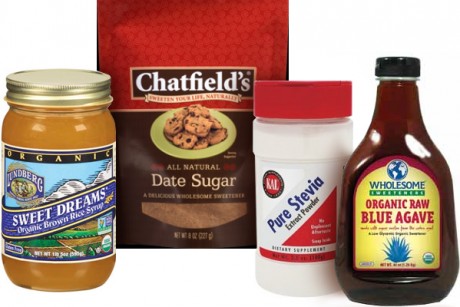
A few natural options.
  If you're still hesitant about table sugar (or insulin resistant/diabetic), there are some other natural options as well.

Other Sweeteners
  Raw honey and pure maple syrup, while still containing calories, are not going to harm you.

  There's also Agave (which I have used --but remain cautious about) and various sugar alcohols. They are naturally occurring, but break down more-slowly in the body (having a lower glycemic index).

  Stevia is plant-based, and contains zero calories. I have tried Stevia, but found it to have a very strong aftertaste. I have used it in baking, and thought it worked out okay.

  Finally, you can try organic cane sugar, which is what I currently use.

  Let's be clear, sugar can be cause for harm. But ONLY when we don't pay attention to the QUALITY of the sugar (artificial or not), and the QUANTITY of the sugar. We're all responsible adults here (is that a bad assumption to make?), so let's take control of what we choose to consume.

  It's my choice to never opt for chemicals. We can have REAL sugar in moderation, and then we won't have to worry about the calories, OR the chemicals.