Showing posts with label training. Show all posts

Sunday, June 29, 2014

Run Club with Nike Portland

Nike Portland Run Club.

  May and June in the Northwest can be frustrating. Summer is near, but the weather may not always reflect what the calendar says.

  Of course, there are teasers on occasion. But usually the warm, sunny days are scattered between week long bouts of gray, drizzly days.

  In the two weeks that I've been home, I've caught myself feeling like it's mid-July or August on several occasions, but obviously that isn't the case.

  What the summer-like weather has allowed me to do is get a jump on a few summer activities. 

  One of those activities is the Run Club at Nike Portland. It's something I've been wanting to do for a while now, but haven't gotten a chance to participate in.

  I've written before about my fondness/obsession with running.

  More often than not though, running is a solo act for me. Running gives me a chance to clear my head, plan out my day, think through whatever might be running through my mind, and just get outside into the fresh air. No matter how the day is going for me, after 35-45 minutes of pounding the pavement (or the sand, when I'm lucky), the day always gets that much better. 

Tom McCall Waterfront Park.
  But there are definite benefits to a run club.

Run Club Plusses
  For one, it makes running social.

  Portland is an active city, and Oregon in general, is a state that runs. So there are a lot of runners, each with their own interesting story throughout the Rose City. Who knows who you might meet at run club!

  It's been said that the toughest step is a runner's first step out the door. Sometimes that is absolutely true. There are days when you just don't want to get out there. Where you're tired, or don't feel like running. If you do make it out the door, the run usually gets better after those first tough steps or those unmotivated thoughts. But the key is getting out the door.

  Having a run club to go to, makes those first steps easier. It's scheduled. You're going to meet people. Even though they'd run even without you there, you're being held accountable to a certain extent.

  Run club also gives you a change from your usual routes/routines. Every route gets tiresome and boring at some point. Why not find a few new ones?

I got to take the Flyknit Lunar 1 out for a spin!
  One benefit is unique to the Nike Run Club, and came as a surprise to me: you're able to test out new shoes and products during the run club. 

   For three weeks at a time, Nike Portland has new shoe models and products available to try out. If you're thinking about a new pair of shoes, or a new gadget, your local Nike store might let you test it out. If it's a new product for you, you can test it to see if it's to your liking before you plunk down the money.

  I tested the Flyknit Lunar 1. And just one test run was all it took for me to decide they'd be my next runner. 

  Finally, Run Club is free, and I'm betting you'll gain more than you lose from participating. Though I did have to pay for parking. 

  Specifics of the Nike Portland Run Club:
  Portland run club meets twice a week, on Mondays and Wednesdays at 6:30, at Nike Portland (on SW 5th & Morrison). They have four different routes they cycle through (Waterfront leftWaterfront rightTerwilliger and the Waterfront Esplanade). Since Portland's downtown sits on the Willamette River waterfront, most of the runs have some pretty scenery.

  Depending on how you're feeling that day, you can choose between a 3, 5 or 7-mile run. All the runs are led by numerous pacers, so no runner will be left behind!

  The warm, sunny Wednesday I went to Run Club there were about 10 other runners. I was told that as the summer weather becomes more and more consistent (usually July thru September), there can be as many as 30-35 runners.

  The out-and-back went quickly for me that day. It was nice chatting up new people, hearing about what they do, what they were training for, what event they had just run, and anything else that might have come up over the course of a 5-mile run. 

  After we made our way back to SW 5th and Morrison, there was water, coconut water, recovery gels and protein bars if we wanted. I've never tried coconut water, so again this gave me the perfect opportunity to test out something new. Can't say I'm a fan, however, so I'll just stick to water.

It's looking a lot like summer in Portland.
A Few Run Club Minuses
  A few things I didn't like: getting out of the city center. It was constant stop and go at crosswalks and lights the first five-plus minutes. Though, once we got to the waterfront, it was fabulous.

  And for me, since I don't work downtown, it's a little difficult to get into the city during the busiest time of the day. But it makes perfect sense for people who already are working downtown, or live close by. 

  There are different run clubs all over the country. They don't always have to be associated with a worldwide corporation like Nike. Sometimes they can just be a group of friends who plan to meet a couple times a week.

  Finding various run clubs in your area can be as easy as googling it, or maybe even check Facebook for a group.

  If running is your thing, or you want it to be your thing, check one out! You won't regret it. I know I'll be going back to the Nike Portland Run Club as often as I can!

Wednesday, January 8, 2014

Triumph Through the Run


Something that keeps me going as I run up those hills -- physical and otherwise


Keep pushing,                                      

Monday, April 15, 2013

Spot Reducing: A Fitness Fib

Dynamic/metabolic training will help you shed body fat.
  
  Tone your arms in 10 minutes! Shrink your belly in 14 days! Pshhhhhhhhhh

  We've all heard it, and we've all tried it. But now is prime time to stop wasting our energy, and realize one thing: We can't spot reduce fat.

  Spot reducing, no matter how hard we try, is impossible.

  Don't think of this as me being negative, or a killjoy, because it's true. 

What is Spot Reducing?
  Spot reducing fat is saying, 'I want to lose weight in my stomach.' Or, 'I don't want to lose fat in my upper body, but I want to slim my legs.' Then we head to the gym and proceed to isolate our 'problem area', and do 1000 sit ups, 200 squats, or 800 bicep curls. We do this over and over, never see the results we are looking for, and get frustrated and discouraged.

Isolation training at its finest: the ab roller.
  Training by isolating only trains, or conditions, the single muscle we are working. It tones that muscle -- whether it'd be our abs, our triceps, or our legs. And that gets us nowhere in regard to burning the layer of fat we're trying to get rid of.

  Furthermore, fat does not convert to muscle. Ever. You have to burn through the fat, while toning the muscle. If there's five inches of fat covering your abs, your stomach won't look any more toned than it did prior to doing 1000 sit ups a day! 
  
Then, How Do We Tone?
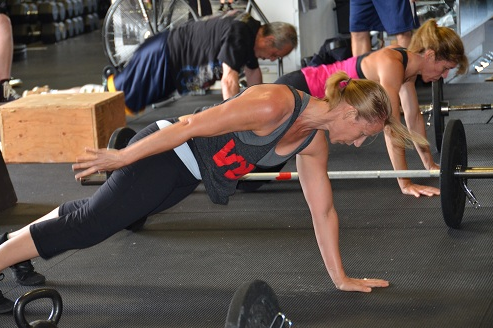
Dips alone won't give you toned arms.
  Say, for example, we want to drop a little extra body fat on the backs of our arms, and tone up our triceps. I bet every single one of us just flashed to someone doing tricep extensions or dips.

  We can do all the tricep extensions, dips, push ups, you name it, our upper arms can handle, but it won't get us any closer to our goal.

  First and foremost, we must reduce our overall body fat.

  Slimming our physique is not easy. But the idea is relatively simple. In order to reduce body fat, we must be willing to work our entire body.

  Our workouts should be dynamic and metabolic. Metabolic workouts burn the most calories, and burned calories equal burning fat.

High Intensity Interval Training is the answer.
  Workouts that are 'metabolic' are workouts where we're simultaneously training multiple muscle groups. High Intensity Interval Training (HIIT), plyometrics (jump training), and circuit training are metabolic workouts.

  These training techniques are most effective because you burn the most calories during your workout, and continue to burn calories after your workout is over -- know as after-burn, or EPOC (excess post-exercise oxygen consumption).

  Cardio workouts (running, walking, biking, swimming) are other effective training methods that burn fat, but don't provide the after-burn that HIIT does.

  On the contrary, isolating one muscle group burns the fewest amount of calories -- another reason doing hundreds and hundreds of sit ups is the least effective way to trim your stomach.

Diet
  Secondly, we need to clean up our eating habits (not necessarily going on a 'diet'). Changing our eating habits means changing our lifestyle. It's a permanent change, not a change that last a week, a month, or a even a year.

  It's focusing on the quantity and quality of the foods we are eating. Most obviously, dump processed foods, as they wreak havoc on our metabolism.

The Science Behind It
  Finally, our bodies will lose/store fat where it is hormonally predisposed to. Generally speaking, women (or estrogen dominant people) store fat in their lower bodies, while men (or testosterone dominant people) store fat in their bellies.

  Yet another reason we can't spot reduce fat. It's based on our biochemistry and hormones.

Ignore the Gimmicks
  Those 'lose back fat' or 'torch belly fat' teasers we see in so many ads are dishonest! Forget the gimmicks and the quick fixes. More often than not, they're ineffective and a waste of energy and money.

  While it may be obvious, or something you've heard dozens of times, it bears repeating: adopt a sound fitness and nutritional plan! It will take time and dedication, but it'll be more fulfilling, and more permanent.

  You want more ideas? Just let me know!
 RELATED POSTS:


LINKS: 
Jillian Michaels Podcast 4/29/2011
Debunking the Myth of Spot Reduction

Friday, March 8, 2013

Fitness on the Go

Bags are packed, where are you headed?

  I don't travel a ton. Sure, I'm away from 'home' a lot. But I would say I'm in a perpetual state of being 'home away from home', as opposed to traveling.

  When I do travel, usually it's long distances (across the pond, for instance!).

  Many of you travel on a regular basis for work, while some of you lucky ducks are able to travel frequently for pleasure.

  No matter the reason, traveling can put the hurt on your health.

  Flying is tiring. Being on a plane zaps your energy, and unless it's a short trip, it kills your day and puts you out of routine. Even road trips are exhausting!

  More often than not, once you get to your destination, you don't feel like doing much of anything. And do I even need to mention the selection of airport/plane food we have to choose from?

  While we might enjoy our destination once we arrive, it's getting there that provides us with some stumbling blocks. So today I offer up two websites that will help keep your health at the forefront, even as you travel!

Fitness While We Fly
  I've often wondered, usually during long, boring layovers, why there aren't gyms in airports. I know I would use it to pass the time during an extended layover, if one was available.

  I don't know about you, but I get a little stir crazy when I have to sit too long. After being on a plane for a few hours, and knowing I have to go back on a plane, the last thing I want to do is sit even longer. So to appease my nerves and my legs, many times I find myself walking the concourses. Whether I'm bored, tired of reading or listening to music, sometimes I just need to get up and move. Before I find myself stuck in the air again, I try to move my body as much as possible.

Usual airport 'entertainment' -- music and coffee.
  But wandering the airport terminal isn't exactly exciting either. Usually it just leads to stumbling into a Starbucks or an ice cream shop for an unnecessary purchase.

  For those of you who think like me, and long for airport fitness centers, apparently they exist. But we just never knew about them! Or I didn't, anyway.

  There's a website that posts listings of airport gyms, exercise centers, and fitness clubs that are either inside airport terminals, or within a short distance of the airport (in the US and Canada).

  I'm not so sure about the latter, however. I probably wouldn't travel outside of the airport to hit the gym between flights. It sounds too stressful (and who wants to have to go through security again, right?).

  But a fitness center or exercise classes, inside the airport? I'd be game for that!

  Instead of sitting in the airport lounge, wandering the concourse halls for hours, or spending gobs of money on airport food and drink, why not hit the gym? I think it's a great idea.

  I'd imagine they charge you a pretty penny for use of the gym facilities, but don't we already spend ridiculous amounts of money in the airport? This would be money better spent, and much better for us! It'd be a great mid-day pick-me-up, and a fabulous way to boost your energy during a long travel day.

  Nothing would make me happier than being able to squeeze a workout in while I'm killing time during a layover.

  Too bad there aren't a few more actually inside the airport (from glancing quickly at the website), and not a short taxi ride away. Maybe they'll start popping up more frequently in airport terminals, who knows!

  Obviously, airport gyms wouldn't be something I'd want to use every time I fly. Sometimes you do just want to veg out and take it easy. But isn't it nice to know you have the option?

  My next travel tip is something you can use once you've reached your destination.

Trail/Route Finder
  Imagine you're new to an area, and want to explore some hiking, biking, or running (even kayaking!) trails. Or maybe you're traveling, and want to get outside for an adventure day on the trails. Here's the website for you: http://www.trails.com/.

Searching for trails in Boulder, CO.
  Punch in the zip code you wish to search, and up pops a map with all the trails within short distance of the location.

  You're provided with the trail length, potential hazards, topography information, and a short summary. You're also able to view the trail map.

  If you find yourself in a rut, tired of doing the same trails and routes over and over again, this can be a great resource to help you find a new activity/route to explore.

  There's a similar website, from USA Track & Field, that allows you to search (by location and trail length) a huge database to discover new running/walking routes. It relies on users to add routes, so if you have a good trail in your city, add it to the collection!

  For me, if you're in an unfamiliar area, it's better to explore an already-proven route. You might not feel comfortable heading out on a run or a walk in an unknown place. But with these trail/route finders, you can do a little research before you head out, and see what you're getting yourself into!

  No matter if we're in the comfort of our own homes, or out seeing the world, our health should be near the top of our list of priorities. I think these two websites enable us to do just that. Pretty handy tools, as far as I'm concerned!


LINKS:

Friday, February 15, 2013

No Fuel, No Burn

About to tackle a workout at Red Rocks Amphitheater.

  We're tackling two workout myths today.

  One: There is no right time to workout.

  Whenever you can fit it in, is the right time.

Early Bird or Night Owl?
  There is, however, an ideal time to exercise. No, it's not a magic hour where you get a better workout, or see better results. It's actually just common sense: try to schedule your workout for roughly the same time every day.

  As with many things, our bodies adapt, they get conditioned. They get used to the exercise day after day, and will start releasing endorphins and hormones at that time, workout or not. It's during these times, you might see peak performances. So if you can, hit the gym at the same time each time you exercise.

  I've even noticed that with myself. I always find myself fitting in my workout at roughly the same time day after day. For a long time, I just thought it was my need for a routine. But boom, when the clock hits 11:30am, I feel I need to get moving.

  I've never been much of a morning person, and definitely have never been fond of morning workouts (I think I had one-too-many of those in my college days). If I have to (as in, there's no other time during the day), I will. But I don't really think I'm at my best during those early morning workouts. To go along with this thought however, maybe if I did it on a consistent basis, I would feel differently.

  Don't worry night owls, people who workout before 7am don't necessarily get bonus points, or any extra burn for their workouts.

  Whatever your magic hour is, try to keep it consistent. And of course, something is better than nothing! So do what your schedule allows, and get it done!

Red Rocks Boot Camp: I'm betting these people had breakfast!
Empty Stomach Workout?
  Two: exercising on an empty stomach is not beneficial. It does not lead to burning more fat.

  People who regularly practice this, rationalize it by saying, our bodies will move directly into burning fat for fuel since there's no blood sugar available. So naturally, we will end up burning more fat.

  In fact, not eating before a workout, or not having sufficient fuel in your body before you workout, often times leads to a less-intense session.

  Since your body doesn't have the necessary fuel, you're weak during your workout. And with a weaker, energy-deficient body, your workout might lack intensity and power. And a during a less-intense workout, you won't burn as many calories, both during your workout, AND after your workout (after-burn, or EPOC -- Excess post-exercise oxygen consumption).

  So ultimately, your calorie burn is less.

  Also, your body burns a percentage of sugar and fat no matter what. So, if your body has NO blood sugar available, it will turn to muscle for fuel, and burn muscle tissue. Essentially cannibalizing your muscle, and that's not good! Keep in mind, our bodies can't convert fat into sugar.

  Long story, short: make sure your body is fueled with, at least, a decent snack before working out!

  Hope these two bits of information help! Have a great weekend!

LINKS:
Exercise on an Empty Stomach 
Jillian Michaels Podcast 12/28/2012

Wednesday, January 30, 2013

Exercise Boosts Brainpower

High Intensity Interval Training.

  I've always felt that exercise clears my head, and makes my mind sharper. But there seems to be some new research that actually backs those feelings up.

HIIT Strengthens Memory
  A study from University of Montreal tracked participants for four months as they followed a workout regimen that included: two 40-minute sessions of High Intensity Interval Training (HIIT), two 30-minute circuit weight sessions, and one moderate intensity workout per week.

  As could be expected, participants lost weight, decreased waist circumference, lowered insulin levels, and increased maximum oxygen intake. The new take-away however, showed that subjects saw a 10-25% improvement in brain functions such as speed, recall, and short-term memory.

  A more in-depth study is in the works to narrow down the effectiveness of interval training and weight training together, versus exercise in general.

  Physically speaking, HIIT (my first blog about interval training) is the most-beneficial, and most time-efficient way to exercise. But now there seems to be an added bonus to testing out HIIT!

Intervals benefit our brain!
Examples of (HIIT) interval training:
  Tabata: 20 seconds 'on', 10 seconds 'off' for eight total minutes.
  Timed intervals: Time on & time off depends on fitness level. If you're just starting out try a 1:2 ratio: 30 seconds on, 1 minute off, for example.

  If you're not doing a timed/ratio interval, there's a more precise way to gauge your exertion and recovery time based on maximum heart rate.

  When you're doing interval work, you want to work around 80% (or higher) of your maximum (this is HIGH intensity after all!).

To find maximum heart rate: 220 - age = maximum heart rate. For example, mine would be 220 - 32 = 188. In this instance, 80% of my maximum is 150 beats per minute (188 x .8). So when I am executing the 'on' portion of the interval, I want to ensure my heart rate is reaching at least 150.

  For the rest period, when your heart rate is back down around 60-65% of your maximum (for me 112-122), rest time is over. It's time to get back to work and start another interval!

To find heart rate: Find pulse on wrist or neck. I can never find it on my wrist, so that never works for me. But theoretically, you can find it there! Count the beats for six seconds, then multiply by 10 (or add a zero).

  Again, using me as an example, when I have 15 beats in six seconds my heart rate is roughly 150 beats per minute (you can check just after you've completed your interval to see if you're putting forth the right amount of effort!). And when I count 11 or 12 beats in six seconds my heart rate is between 110 and 120 beats per minute, so rest time is over!

  It may sound difficult, or too confusing, but it really isn't once you get the hang of it! Or you can make things really easy by using a heart rate monitor, but another gadget really isn't necessary.

  Try the intervals for 20 minutes. As you get stronger, and build better endurance, you can add time to your workout. Here are some more example interval training workouts if you're just starting out.

  Let me know if you see (and feel!) some results! And as always, don't forget to warm up and cool down!

  LINKS:

Friday, January 25, 2013

Cardio or Weights First?

Team workout in Germany.

  You've made it to the gym, what should you tackle first? The weight room, or the treadmill?

  Even the experts can't agree. Many of them have different answers, and different preferences. But truly, the answer depends on what your goals are. What are you trying to accomplish in your workouts?

  Are you trying to get stronger, improve cardiovascular training, or lose weight/fat?

Train With Your Goals in Mind
  Ironically enough, your fitness goals will tell you what you should do first! If your goal is to become stronger, and increase muscle: hit the weights first. If your goal is to increase aerobic endurance, or lose body fat, perform your cardio first

  The ultimate, most-efficient way to exercise is to do both, cardio and weights, at the same time via circuit training. If done at a high pace and intensity, circuit training can be considered a form of High Intensity Interval Training (HIIT).

  The key to circuit training is that there is no rest. At least not the kind we're used to seeing. Never are you just sitting or standing (in between sets) idly doing nothing. Your rest time is active rest, either by moving to a different muscle group, or doing a cardio interval, as the muscle groups you've just worked, recover.

  By training in this fashion, your heart rate is always elevated, working both cardiovascularly and muscularly.

Weights First, Hypothetically
  If you prefer to focus on one thing at a time -- strength training and cardio separately -- it is said to lift weights first.

  You should do strength training first because at the start of your workout, there's more blood sugar available to burn through. Your muscles will have a more powerful contraction, resulting in a more powerful workout. You get the most out of your muscles by lifting weights first, and then finishing with cardio.

  Hypothetically, you burn through the available sugar (during the weight session), and during the cardio session, your body moves into burning a higher percentage of stored energy (fat). I say hypothetically because there really isn't much research to back up this assertion. 

Personal Preference and Consistency
  I also look at it like this: what do you prefer? What is your routine? In my opinion, whatever keeps you going on a consistent basis, is the right way to go.

  For me, I prefer to do my cardio first because I like my muscles and body to be warm when I start lifting and doing more-explosive exercises. But, I also am not throwing around extremely heavy weights either, so needing a high level of power isn't as necessary. I have not 'maxed out' (or anything close to it) in the weight room in quite some time!

First season in Sweden. 2008-2009.
  You also might find yourself skipping the second part of your workout (because you're tired from the first part, or are running short on time), so do whatever you enjoy doing the most, first. You're going to put a better effort into something you enjoy over something you despise!

  Likewise if results are most important to you, do what coincides with your goal, first. So if you do skip part of your workout, it's not the part that's the most important!

  I can speak from experience about this too. On the occasions when I do lift before running, I find myself lagging and wanting to cut my cardio workout short. And I always want to get a good cardio burn in, so I prefer to focus on my cardiovascular goals. 

  All in all, despite what you are good at, or what you like, it all comes down to what your goals are, and how much you value accomplishing those goals.

  If you have a goal to lose stomach fat, doing 1000 sets on the bench, or any other muscle-isolating lift, isn't going to help you reach that goal. And vice-versa: if you're trying to get more explosive muscles, running for hours on end on the treadmill isn't going to get you any closer to accomplishing that goal.

  Take a look at what you want to accomplish, and go from there!

 LINKS:

Friday, January 18, 2013

Foods That Heal

So many years on the court has made for sore joints!

  Achy knees? Sore ankles? Yeah, me too.

  After years and years and years of constant pounding, running, and cutting, my joints are starting to get a little angry at me. I'm actually a tad surprised it took this long.

  Being somewhat crippled (I say that jokingly now) as I grow older has always been in the back of my mind. But running, jumping, cutting, all in all: abusing my body, is part of the job. There's no way around it. I'm just trying not to let 'somewhat crippled' become a reality.

  This season, for the first time ever, I've had sore knees. And more often than not, I wake up to ankles that take a few minutes to warm up when I first jump out of bed in the morning.

  My question is this: can I stop it?

  I'm a person who, no matter how long my career as a basketball player lasts, will always be active. I've blogged about how much I enjoy running. And working out, and being active on a daily basis will always be a part of my lifestyle. Not doing anything isn't an option.

I may need more than the occasional physio tape.
  Sure, I can adjust. I can swim, I can bike. I can do lower-impact activities. But I don't enjoy them nearly as much.

  Outside of changing my activities, what can I do?

No Drugs
  I don't like taking pills. Whether it's over-the-counter medication or prescription, taking pills is my last resort -- only in extreme situations. They are extremely hard on our bodies, and only mask the under-lying issue. I have a future blog on NSAIDs -- Advil, Aleve, etc -- in the works, to explain why I'd rather not take pills. But that's for another day.

  We know how to aid our muscles' recovery, but what about our joints'? I'm trying to find other solutions. Solutions that are easier on our bodies than pills.  

Tart Cherry Juice
  Tart Cherry Juice affects the body's ability to recover from strenuous activity. Mostly, it aids the body in muscle repair after exercise and strength training. Because the juice also has notable anti-inflammatory capabilities, it can alleviate joint pain (due to arthritis, gout, and I'm hoping, over-use).

  A study done on Hood to Coast (a 196-mile relay in Oregon) reported that runners experienced significantly less pain after the race if they drank tart cherry juice in the week leading up to the race.

  Other tart cherry juice benefits: it's very high in anti-oxidants -- including the heavy-hitter Quercetin (see below), and it's a natural source of melatonin, so it may help you sleep more-peacefully!

  Dosage: Eight to 12 ounces, twice per day (the equivalent of 100 tart, or Montmorency, cherries per day).

What I loaded up on during Christmas.
  One downfall: The stuff is a little pricey. Make sure it's 100% tart cherry juice or concentrate! When I first looked for it at the store this summer, I found watered-down, or other juice-mixers, were easier to find (and easier on the wallet!). So if you're looking for the benefits, make sure it's 100% tart cherry!

  If you're curious, sweet cherries have not been shown to have the same effect.

  I tried tart cherry juice on occasion this past summer. But I didn't drink it often enough to really decide if it was anything that was of benefit to me. Since my knees and ankles were achy the first half of the season, I thought I'd give it a try during the second half of the season. So, I came back to France with a couple bottles of tart cherry juice concentrate.

  I will be diligent in the dosage, and let you know what I think!

Healing Foods
  We can help heal ourselves with food instead of pills. Believe it or not, our diets can provide a lot of healing powers. Even when injured, what we eat can actually get us back on our feet sooner rather than later!

  Here are a few easy ways to adjust our diets:

  Foods can hurt us, or they can help us. Instead of opening up the medicine cabinet, let's give our food a chance to be our medicine.

  As always, if you have any tips or tricks, I'd love to hear them!

 LINKS:

Wednesday, December 5, 2012

There's an App for That

Nike Training Club app
 
  Eating healthy, sticking with our workouts, finding new, refreshing recipes -- living a healthy lifestyle really can be overwhelming! It can consume a lot of time. And if we don't have that time in abundance, it's far-too-easy to slip into the status quo, the do-what-we've-always-done routine.

  As always, I just want to help! I've found a few tools that hopefully will help keep us on the healthy-living track.

  Many of us have made the jump, and now enjoy the benefits of using a smartphone. Whether it's an iPhone, an Android, or whatever else there is to choose from, there are a few more things that our smartphones could be doing to make our lives easier.

Fooducate app
  I'm sure everyone knows about the calorie counter, recipe finder, or fitness tip apps. But what about when you're in the grocery store, and you find yourself staring at a list of ingredients that requires a PhD in chemistry to understand? Or maybe you have a food allergy, and you're unsure if a product is okay for you to have? Or, it's late in the day, and you really want to get a workout in, but you can't get out of the house, or you find yourself fresh out of ideas?

  Fortunately for you, there really are apps for all that! And they're free! (And most are available for iPhone/iPad and Android.)

Food Apps
  • Fooducate - Scan the bar code of any product in the grocery store, and this app will grade the product nutritionally, point out red flags (high fructose corn syrup, high salt, GMOs, etc), provide alternative suggestions, and more.
  • True Food - Trying to avoid GMOs? This app will help you do just that! Though it looks to be a bit outdated, most the information remains relevant. 
  • Shop No GMO - This app is a shopping guide to help you identify and avoid GMOs. Good idea, but the app freezes a lot. Hopefully they're working on a fix. 
  • What's On My Food? - Lists and identifies the foods that have the most chemicals on them, which of those chemicals may be most-harmful, and how you can avoid them. Again, a little out-dated.
  • Epicurious - Lets you search almost 30,000 healthy recipes from various resources. 
  • Harvest to Hand - This app helps you find locally harvested food, farmers markets, specialty shops, etc.
True Food app.
Fitness Apps
  • Nike Training Club (NTC) - Basically like having a personal trainer in your phone. You choose from dozens of set workouts that you can do almost anywhere. Has instructional videos. Push play, and go! (iPhone/iPad only)
  • Nike BOOM - Similar to the NTC app, but geared more towards men, in my opinion. Can be sport-specific, and has modes for warm up, workout, and interval training. 
  • MapMyRun GPS Running - Allows you to search for new running routes, maps/tracks your runs. Also available for cycling (MapMyRide).
  • Livestrong.com MyPlate Calorie Tracker - Tracks your daily calories and exercise.
  • Nike+ Running - Similar to MapMyRun. Tracks and maps your workouts. 
  These are just a handful of apps I either use myself, just downloaded and intend to use, or have read about. I'm sure there are many more than I haven't yet stumbled onto. And chances are, if there's something specific to you, or something you want to know more about, there's an app for that as well!

  Have you found an app that you use, and want to share? Let me know!

  LINKS:

Wednesday, November 28, 2012

Amp Up Your Workouts with High Intensity Interval Training (HIIT)

Red Rocks. How's this for an interval workout!?!

  The Holiday Season is here!

  For many of us that means busier schedules, and yummier foods than usual. And if exercising is a part of our regular routine, maybe we should try to get more bang for our buck in the workout department to go along with our hectic holiday lives.

  Or maybe we've hit a plateau, or are bored with our workouts, and are looking to spice things up a bit? Maybe pounding away on that treadmill or bike is getting tiresome? Whatever our workout-complaints are, here are some ways to shake things up a bit!

  These are some tried and tested ways to amp up your workouts, change the status quo, and get your heart thumping: 

HIIT -- (High Intensity Interval Training) is exactly what it sounds like: intense cardio performed in a series of intervals.

Luscher Farms -- my field of choice for sprints.
  What makes HIIT any different, or any better, than your run-of-the-mill cardio? The payoff for a shorter, more-intense workout is that after a HIIT session, your body spends the rest of the day expending energy to recover!

  This is called EPOC (excess post-exercise oxygen consumption), or 'after-burn'. It means that you consume a great deal more oxygen recovering from the workout than you would have if you'd just done a steady-state workout.

  HIIT allows you to burn "up to nine times more fat while sitting on the couch later that night than you would have if you'd spent an hour on the treadmill at a moderate pace." But it has to be intense -- no slacking allowed!

Three examples of HIIT that I use on a regular basis, mostly in my off-season are:
  • Hills/Stairs -- Find a hill, or a set of stairs, in your neighborhood -- something that takes roughly 20 seconds to run. After a sufficient warm up (10-minute jog, for example), perform a series of 10-15 sprints up the hill, or stairs. Walk, or jog back down for your recovery, and repeat. After 10-15 repetitions, finish with a 10-minute cool down (and don't forget to stretch!). This works the same if walking is your preferred method of cardio!
  • Sprint Intervals -- If you can't find a hill or a good set of stadium stairs, surely there's a field or track in your neighborhood! Again, after a good warm up, it's time to hike up the intensity: sprint for 50 yards. Then recover, by either jogging or walking, for another 50 yards. Repeat for 10-15 minutes. I like to do my sprint intervals on a football field because it's a nice flat/soft surface, and the distances are already marked for me. I don't need to look at a watch, I just sprint 50 yards, then recover for 50 yards. No thinking involved, just run! And don't forget your cool down!
  • Machine work -- Both of these workouts can be performed on a treadmill, bike, or elliptical. For hills/stairs, you increase the incline for 20-30 seconds, then return it to normal for your recovery time. For the sprint work, you increase the speed for 15-30 seconds (depends on how hard the sprint is!), and then return it to a comfortable pace for your recovery. Again, these can be done as walking workouts as well!
Tera and I getting ready to run the stairs at Red Rocks.
  The point of interval workouts is to raise your heart rate very quickly, and then during your recovery, return your heart rate to a lower pace. This will increase your fitness level overall (you will recover quicker the more often you do it).

Push Outside Your Comfort Zone
  The trick is that you have to push yourself out of your comfort zone: the more you push yourself during the 'sprint' phase, the better results you will see. And of course, the more 'after-burn' effect you will see.

  Clearly you need to have a good base fitness level to perform HIIT workouts. You can't just jump off the couch, straight into sprint workouts. That's a recipe for disaster. And you should not do HIIT workouts every day. Your body needs time to recover from intense workouts, and should only be done two to three times a week.

  If you find yourself having difficulty maintaining a high intensity throughout your workout (or want to give interval training a try, and you're new new to the working out game), you are better off performing more moderately-paced 'endurance' cardio. But try to push yourself with a few harder minutes sprinkled in throughout the session. This will help increase your metabolism (although not as much as with HIIT), as well as your overall fitness, which may lead to you eventually including HIIT workouts as part of your routine.
  
High Intensity Interval Training.
Tabata Training -- is a very specific, rigorous kind of HIIT. Tabata is becoming more and more popular because it can be done very, very quickly and it simultaneously improves your anaerobic AND aerobic conditioning. Tabata develops your ability to sustain explosive bursts of strength and speed, along with improving endurance. 

  If you TRULY only have 20 minutes to squeeze in a workout, try Tabata, it'll torch you! I have given it a shot a few times this season, and have found my legs were shot the next day. Something I never feel the day after something like a 40-minute run.

  Again, it is suggested that you have a good, if not GREAT, fitness level for Tabata training -- because if you cannot sustain the intensity, you will not see the results in the short time.

  Any exercise can be incorporated into Tabata training. Pay close attention to the 'sprint' phase, and the recovery phase: notice that the sprint-time is twice as long as the rest-time. The basic outline of Tabata training method is:
  • 10-minute warm up
  • 20 seconds of intense training (all out sprint)
  • 10 seconds of rest 
  • Total of 8 sessions/rounds (making the entire Tabata session 4 minutes long)
  • Cool down and stretch
  True Tabata training is not supposed to last longer than one session.

  Whether you're looking to spice up your workout, or get a more-intense workout, in a shorter time, give interval training a try! Your extra hard work will pay off. And it's always good mentally and physically to change up your routine -- it keeps us on our toes, and forces our bodies to adapt.

  Good luck, and let me know what you think!

LINKS: 

Wednesday, October 17, 2012

Game Day = Test Day

France '12.

  If there's a day of the week I need to be at my best, it's Saturday.

  It's the equivalent of test day back in our school days. We put in the work during the week, to hopefully earn that passing grade, a win, come Saturday.

  It's game day.

  That's when it all matters. Why we put in the work. Why we get paid. Fans are there. Family and friends are there. Media is there. It's your one time during the week to show your stuff.

  With so much on the line, you obviously want to be at your peak, both physically and mentally. Not to mention it's your job to be at the top of your game. If you're not, you're letting your teammates down (not to mention yourself!) and your opponents will quickly take advantage.

  Nothing frustrates me more than not playing my best come game day. Unfortunately it's been known to happen. So I do whatever I can to physically prepare myself for Saturday. If that means I need to do a little extra work, so be it.

Balancing Act
  Each, and every week, it's a constant battle to find the right balance between preparing yourself, while not over-doing it.

  If you do too much over the course of the practice week, you find yourself sluggish, with tired legs on Saturday. Hardly at the top of your game. If you take it easy during the week, on Saturday you're soft, lethargic, maybe even getting winded too easily. Again, far from your best.

Germany '09-'10/
  But if you find that balance, the sweet-spot, you feel like you could play forever. You have a rhythm for the game. Your legs are there throughout, and you recover quickly when you get tired. It's your goal to feel like that every week.

  For me personally, I need to be ready to play anywhere from 35 to 40 minutes a game (of a 40 minute game). That means I need to be in great shape. It's tough to play at a high level for 35+ minutes!

  I've found that taking it easy during the week, and saving your legs, is not going to cut it. For me anyway.

When Practice Doesn't Cut It
  In a perfect world, you get all your necessary preparation in practice. And there would be no need for extra work. But I've found in the last few years, I don't always get what I need out of practice.

  For example, sometimes we don't have 10 players. When that's the case, we're unable to go up and down the court and play five-on-five. There's not a drill in the world that can simulate playing full-court basketball at an intense level, so obviously that is the best way to prepare physically for games.

Sweden '08-'09.
  On those days, where I feel like practice didn't get me ready for Saturday, I have to do a little extra work on my own. That might mean a day of extra shots at game speed, or extra running/cardio, or maybe an extra session in the weight room. Or maybe all of the above.

  It depends on the week, and it depends on how I'm feeling. Over the course of my career, I've learned to trust my body. And think I have a pretty good idea of what I need to be at my best.

Training For a Game, Not a Marathon
  But sometimes it's about mental health and happiness too.

  Since I love running, the easy thing for me to do would be to go out and run 20, 30, 40 minutes. Nothing makes me feel better than being outside, clearing my mind, working up a sweat, while on a run.

  While that might give me a good workout and a mental release, running long distances isn't the most efficient way to train during basketball season. It's probably not in my best interest to be out there pounding on my legs day in and day out. That would be overdoing it. And my time and effort could be used doing something more-applicable to basketball.

  So I've come to realize that I might have to sacrifice wanting to go out and run everyday in order to be ready to play on Saturdays (even when I look out my window and see runners racing by!). While running might make me feel better in the short term (that day), a few days down the line, I might find myself tired. And I can't have that.

2012-2013 team.
  Outside of a recovery run early in the week, I'm trying to stay away from pounding the pavement. And instead, I'm giving interval training a try. Either on a bike or an elliptical machine, simulating short sprints (like you find in a basketball game) with even shorter recovery time. It's a sure fire way to get your heart rate pumping fast (without the wear and tear and pounding)!

  It's something new for me, so we'll see how it goes!

  I'm always experimenting and exploring things I can do to make myself better. I want to be in tune with my body, and always do what's right in order to be at my best come Saturday. I realize it's important to allow time to recover after physically demanding games. And it's an extremely long season, that we've only just begun!

  So I'm working now to find that balance -- to earn that A on game day!

Friday, September 14, 2012

Got Coffee?

Starbucks in Germany!

  (Note: As luck may have it, I came across an in-depth look all about coffee, and its benefits over the weekend. Check it out here!)

  It's Friday, so it's safe to say a few of us might have needed a little stronger cup of coffee to get rolling this morning. Or maybe an extra cup or two sufficed.

  Those of us who have picked up the coffee habit rely on it for several reasons. Whether it's that boost to get our day started or a midday pick-me-up, the comfort of a warm drink or a morning ritual, a workout enhancer, an excuse to visit with a friend, or just because we like the taste, coffee is the most common way we consume caffeine.

  And depending on who you talk to, caffeine is either beneficial, or a harmful vice. So which is it?

The Biology 
  Caffeine is a stimulant. Biologically it's revs up our nervous system, decreases fatigue, and helps us feel more alert. It does this by blocking the Adenosine (known as nature's chill pill) in our brains. So there's a reason we get a boost after consuming caffeine!

  It's fair to say that the majority of us (as adults) consume most of our caffeine in the form of coffee. So the answer to whether it's harmful or helpful, most likely, lies in how much coffee we drink on a daily basis, and how we drink it.
Always good reason to stop in for a coffee with friends!

How Much Caffeine?
  Everywhere you look, the 'acceptable' amount of caffeine per day is roughly 300-400 mgs. Because there are so many different ways to brew it (and each way yields a different amount of caffeine per serving) the range of how many cups per day is dependent on how you brew your coffee. Lucky for us, someone has already done the math!

  Starbucks is probably the most well-known and most-frequented coffee spot throughout the US, so here's a complete guide to how much caffeine is in their countless coffee drinks (there is information about other caffeinated drinks, as well). And if you brew your coffee at home, you can use it to guide you as well. 

The Benefits
  Other than the obvious, and previously talked about, boost in the morning, there are other advantages to consuming a 'healthy' amount of caffeine on a daily basis.

  Caffeinated coffee has been shown to boost cognitive function, is an anti-oxidant, inhibits insulin resistance, and can speed up your metabolism.

  There's one benefit to caffeine that I had never considered until recently. More studies have been released about the benefit of consuming just a small amount caffeine 30-45 minutes prior to exercising to performance. Again, since it's a stimulant, caffeine gives you extra stamina and increases your heart rate, which improves blood flow to the rest of your body. It helps you perform difficult physical tasks by eliminating fatigue. Caffeine also increases the amount of adrenaline in your system, causing a rush of extra glucose and oxygen to your muscles.

  Caffeine has been found to help with two kinds of exercise: endurance activities, and short, power-intensive activities. 

The Drawbacks
  As with everything, coffee (caffeine) must be consumed in moderation. When we exceed the 300-400 mgs per day suggestion we may start to see negative effects. Sleeplessness, increased anxiety, and headaches are common results of too much caffeine consumption.

  A more serious result of over-caffeinating ourselves can be the effect our thyroid function. The thyroid controls our body's metabolism. Too much coffee can, in turn, cause the release of stress hormones and burn out our adrenal glands, resulting in weight gain.

  Lastly, because caffeine is a diuretic, we must drink water alongside consumption to avoid dehydration. 

How Do You Take It?
   I know very few of us actually LIKE the taste of coffee, and coffee alone, when we first start drinking it. We need a little (or a lot) of sugar and/or cream to doctor it up a bit to our liking. So be mindful of how much sugar and cream you take.

  But one thing is certain: please avoid the artificial sweeteners!

Hanging in the coffee bar in Italy.
  Green tea is a good non-coffee option for caffeine. Stay away from the energy drinks because more often than not, they're loaded with sugar or artificial sweeteners. Get your caffeine in a 'natural' form if you must!

  Bravo to you, if you've never picked up the coffee habit! I can't say I am one of those people. For me, it all started in Italy. The Italian espresso has to be one of the best things ever! Before I moved onto playing in Europe I would occasionally have a 'coffee' drink from Starbucks. But based on my preference for strong, bold coffee, I have a hard time calling those sweet drinks, coffee, now.

  I know when I'm sitting in front of my computer, working on a post, I can mindlessly drink three or four cups in one short afternoon. It was after I thought about my new habit, that I was curious: exactly how much coffee is too much?

  To be sure, as with everything good in this world, it's all okay in moderation!

LINKS:
The Complete Guide to Starbucks Caffeine (and other sources)
Caffeine Before Working Out
Health Benefits of Caffeine
The Effect of Excess Caffeine