Wednesday, April 10, 2013

Easter Sunday in Amsterdam

I Amsterdam.

  A regular Sunday in Europe is quiet. Many stores and shops are closed, even in a city the size of Amsterdam.

  There will be pockets of small shopping districts open, but for the most part, every thing's closed up for the day. That's just the way Sundays are.

  They're for taking Sunday strolls, Sunday drives, and relaxing.

  Easter Sunday in Europe? Yeah, you can imagine.

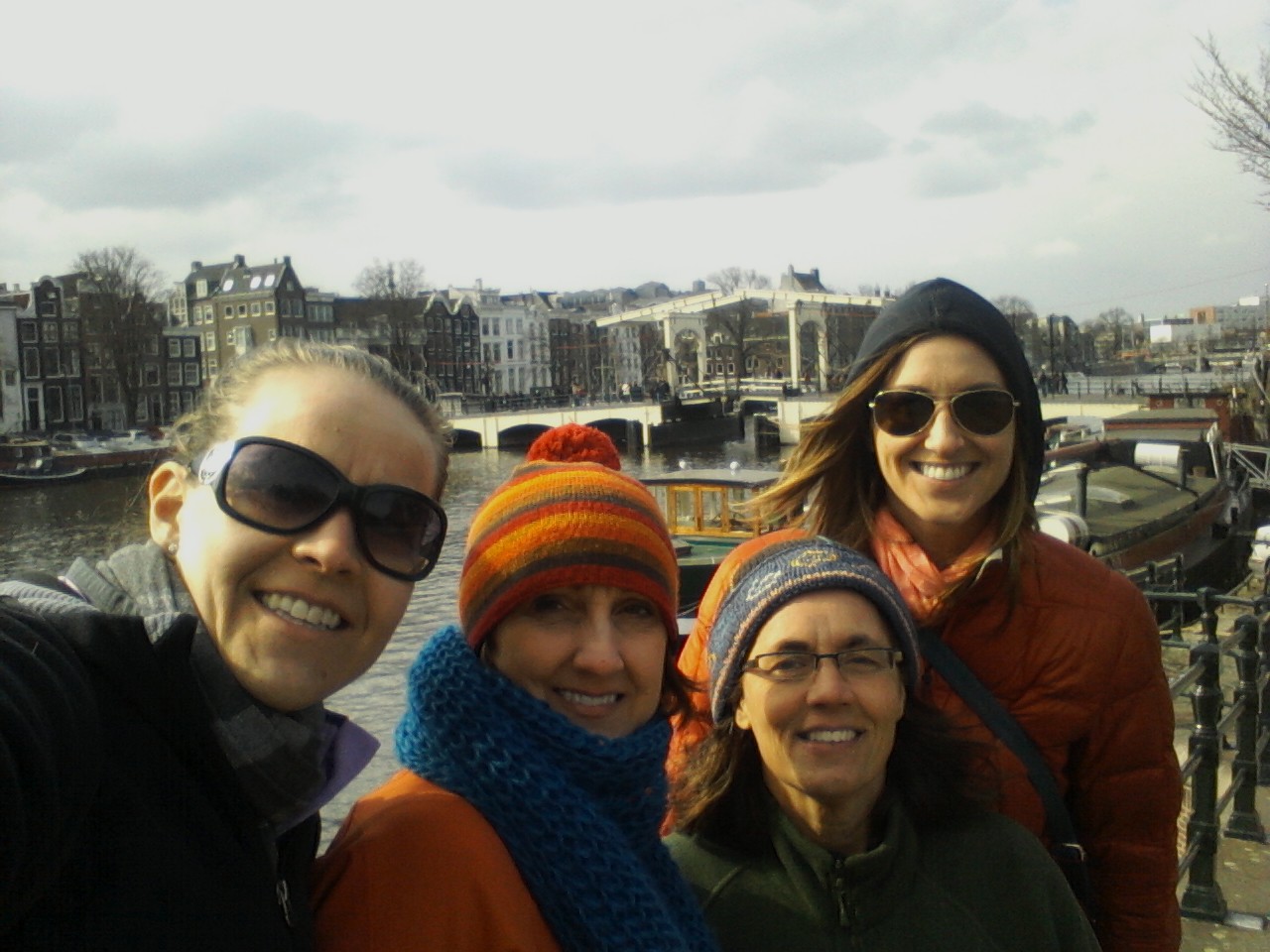
  Tera, Tracie, Rene and I were about to see what Easter Sunday had to offer in Amsterdam. I was hoping it was more than gesloten sign after gesloten sign.

Rijksmuseum and I Amsterdam sign.
SUNDAY
  We 'sprung forward' Saturday night and it put us behind schedule right off the bat (Europe changes to Daylight Savings several weeks after the US. So Tracie, Tera and Rene were lucky enough to spring forward twice this year!). We had chronically been a few hours behind scheduled-plans the entire weekend, so one less hour didn't help matters.

  Most of our time, the two days prior, had been spent in the western and northern parts of the city, but there were some sights south of the city center that I wanted to get to. We scrambled out the door, and headed for the southern part of Amsterdam.

House boats lining the canals.
I Amsterdam Sign
  The I Amsterdam sign is one of the most-photographed spots in Amsterdam. Initially, the phrase was used as a marketing campaign, but quickly became a motto of the city.

  Located just in front of the Rijksmuseum, you commonly see tourists crawling all over the giant letters to capture a fun picture for their Amsterdam photo album.

  When we came upon the sign, we found exactly that. It was difficult to gain a good perspective for pictures because there were so many people, but we managed to snap a couple good shots.

  The whole area surrounding the sign, known as Museumkwartier (Museum Quarter), was interesting. There's the Rijksmuseum -- the national museum, the Van Gogh Museum -- that houses the largest collection of Van Gogh's work, the Nederlands Filmmuseum -- that showcases 1000 screenings a year, and a few other museums.

The basketball court in Museumkwartier.
  There is also open space, Museumplein and Vondelpark, that give the neighborhood a nice atmosphere. There was even a basketball court!

Easter Market Goose Chase
  In previous years while traveling on Easter weekend, I had always found many of the cities had Easter Markets. We were hoping, since most-everything else would be closed, that maybe there would be a market for us to enjoy.

  I had done my homework, but forgot to make note of where the markets were. Oops! One difficult thing about traveling in Europe, is it's hard to research on the fly. Unless you want to pay an arm and a leg for your phone to work abroad, your smart phone is merely a glorified map. And public wifi is hard to come by, so you can't count on being able to Google anything once you're out and about.

  So I asked a vendor where there might be an Easter Market to stroll though. He then sent us on, what turned out to be, a wild goose chase for the Albert Cuyp Market. He said it was 'one of the most famous markets in the world'. I thought, wow, this should be great -- if we could find it.

  We set out for the De Pijp neighborhood and the Albert Cuyp Market. We found where it was supposed to be, but all that was there were quiet, empty streets. Guess what, it's not open on Sunday.

  It was a sunny day (but still pretty chilly), so we were happy to be out in the fresh air and sunshine. As we made our way from the closed Albert Cuyp Market, back towards the city center, we had our eyes peeled for a place to have lunch.

  We walked along Utrechtsestraat until we found a spot that grapped our attention: Zuivere Koffie did just that. For the second day in a row, we felt like we found a winner. This cafe wasn't quite as good as Singel 404 from the day before, but still a good stop for sandwiches and coffee or tea.

Zuivere Koffie for lunch.
Cafe to Cafe
  Almost immediately after lunch, I had planned to meet a high school classmate at yet another cafe along the Amstel river. I can never have enough coffee, and was anxious to try out another Dutch dessert, so I didn't mind.

  I hadn't seen Ariel since high school graduation, so it was fun to catch up on the last decade-plus (wow!) for a couple hours at De Ysbreeker (pronounced ice breaker).

  I love how Facebook and traveling can put you back in touch, and it's always fun to see a familiar face so far away from home.

  Along with a few cakes and coffee, Ariel introduced us to a Dutch specialty called bitterballen -- fried gravy. I'm usually not partial to fried anything, but they were good!

  The day was winding down, and there was nothing more in particular we wanted to see (that we could do in a short time frame), so we were happy to slowly make our way back through the city.

LHS grads in Amsterdam -- me and Ariel.
  Right before heading back to our house via tram, we came upon Rembrandtplein, one of the largest and busiest squares in the city center. It was a lively part of the city, with an art market in the square that afternoon.

  I had been wanting to get to Rembrandtplein all weekend, but hadn't managed to be in the right place at the right time til then. And since we were short on time, we didn't get a chance to explore the square and the surrounding area.

  Because I had a three hour drive back to Dunkerque (by way of Brussels to drop my friends at the airport), I didn't want to get on the too road late. But as usual, we were behind schedule. So it was time to hit the road!

Summing up Amsterdam
  Usually, after visiting a new city for a weekend, I have a very good feel for the layout of the city by the time I leave. I can't say I felt that way after our weekend in Amsterdam. I found it more difficult than usual to get my bearings. Even though the city isn't all that big, I never felt comfortable with my sense of direction, or exploring without a map.

Where the Amstel river turns into the canals -- I think.
  With the countless canals, every corner and crossing felt the same. You'd try to remember 'that place' by the bridge, and then you come upon 12 other bridges that look nearly identical.

  Also I usually feel very comfortable with public transport. In Amsterdam I explored less than I usually do, and really only rode one tram the entire weekend -- always getting on/off at the same stops.

  From what I saw over the course of the weekend, the best way to explore Amsterdam is to get lost on a bike. The days we were there, were not fit for biking -- too cold! Walking does the job too, but to fit in like a true Amsterdammer, you definitely need a bike. And a bell to ring at all the wandering tourists that walk into your path!

Near Staalstraat.
  After three days in Amsterdam, I came to this conclusion: it's essentially two different cities. One inside the Red Light District, and one outside the Red Light District.

  The one inside was pretty overwhelming, and not exactly my cup of tea. But the one outside, was a place I loved.

  It had pretty scenery, friendly people, international fare, great sights to see, and on top of it all, was health conscious. The Dutch, to me, seem to be committed to living a healthy lifestyle, and make it easy for their citizens to follow suit.

  If ever there was a European city I could see myself living in long term, it would be a place like Amsterdam (outside the Red Light District, of course)!


Tree art.
Rembrandtplein.
On the move!
Art in Amsterdam.
Rembrandtplein.

Along the Amstel river.
Rene's little cream to go with her little coffee.
You see this everywhere --  it's the Amsterdam flag.
Amstel river.
Rene -- I Amsterdam.

Me -- I Amsterdam.
One last group picture!
De Pijp neighborhood.
Rembrandtplein.

Monday, April 8, 2013

Amsterdam Day Two: Anne Frank, a Boat Tour & a Little Shopping

 A common sight in Amsterdam: a canal bridge, lined with bikes.

  The first night in Amsterdam had given me one perspective of the city known for its Red Light District. The craziness, the circus-like atmosphere, the anything-goes feeling, had left me a little unsure of the Dutch capital.

  But with two more days to explore Amsterdam, I was anxious to see the other side that I knew lay somewhere in the city. 

SATURDAY
  One sight that was first on all of our lists to see was the Anne Frank House. Without a doubt, being Easter weekend, and with a lot of tourists in town, it would be a busy place. The plan was to head to the museum right away, and see how long the line was to get in. We knew the house, and attached museum wasn't all that big, so surely, not very many people could be inside at once.

Sights from the boat tour. Draw bridge near the Amstel River.
Tram Adventures
  Just as we had the night before, we hopped on the number 13 tram, and headed towards the city center. Our ride, roughly 12 hours prior, had been a smooth one. And since we were going to the same place, I expected this ride to be just as easy. Only this time, I wanted to buy a 24-hour pass, instead of paying a pricey 2.80 € for a single-hour pass each time we rode the tram throughout the day. 

  It was here that we encountered the only language issue of the weekend, and in return, got a pretty funny story. As I boarded the tram with Rene slightly behind me, I told the tram attendant I wanted a 24-hour pass. He replied, 'five ten euros'. I reached into my wallet, and thought there must have been a weekend price, because the price listing in front of me said it was over seven euros for a 24-hour pass. Nevertheless, I gave him 6.10 €, and waited for my ticket and change.

A pirate ship! A replica of the 1749 Eastindiaman Amsterdam.
  The attendant then shot me the 'you dumb tourist' look and said, 'no, FIVE TEN euros' in a stern voice. Confused I said, 'yes, and I'm giving you six ten'. 

  This exchange repeated at least five times, with the attendant getting louder and more agitated with each passing second. 

  He eventually started flashing a five and a ten with his hands. I laughed cause I still had no idea what he was asking for. The tram was getting busier, and we were still no closer to an understanding.
Cruising through the canals.

   Suddenly, it hit me: FIFTEEN euros! He thought I was buying two tickets, one for myself, and one for Rene. I shrugged it off, gave him more money, got our two tram tickets, and laughed to the back of the tram.

  Ahhhh, adventures in a foreign land!  

  Westermarkt was our stop for Anne Frank, and all it took was one glance to see that we were in for a long wait.

  With temperatures hoovering around freezing (Spring remains a distant wish in Northern Europe), we decided to pass on the museum that morning. I'd read the night before that lines for the Anne Frank House tended to be much shorter in the evening. So we'd return later that night, and give it another try. But to be sure, we didn't want to miss the Anne Frank experience.

Touring the Streets & Canals
  Second on the the to-do list was a boat tour through the canals. Amsterdam has 165 canals surrounding the city, and is known as the 'Venice of the North'. To visit Amsterdam and not see the city from the canals would be as tragic as not taking a stroll through the Red Light District.

More sights from the canals.
  There were countless tour companies to choose from, but we opted for Blue Boat Tours. Now all we had to do was get from Westermarkt to Leidseplein.

  Even though it was a chilly morning, the mile walk wouldn't be all that bad. And it would give us the opportunity to see a bit more of the city.

  As we strolled south towards Leidseplein, we stumbled upon a little shopping. De Negen Straatjes ('the nine streets') is a shopping district that consists of nine side streets lined with local boutiques, cafes and art galleries. We explored the shops for a bit before heading back out to find our boat tour. My friends and I would return to De Negen Straatjes a little later in the day.

Tracie & Tera outside the cafe.
The boat tour! 
  The Blue Boat Tour was like every other boat tour I've been on. Nothing really special, but a convenient tourist stop. It was fun to quickly see the city, and see the sights from the perspective from the canals. 

  The tour took us out to the IJ (the open water, that I initially mistook for a river, north of the city center), and through the various waterways surrounding the city. You could see the forward-tilting houses, the many houseboats (2,500 of them in Amsterdam), and bridges (1,281) that line the canals. 

  There was a lot to take in during our 90-minute tour; definitely a worthwhile experience!

Lunch Time
  After some research by Rene, we had a lunch spot already in our sights. One of the harder things about traveling in a group is deciding on where and what to eat. People might have a different idea of what sounds good, especially in a foreign land. 

  Rene read off a rave review of a local place called Singel 404, and all four of us decided it sounded delicious. So once off the boat, Singel 404 was our destination.

Delicious -- Singel 404.
  We easily found it (convenient naming your cafe after your address), and just happened to beat the lunchtime rush (even though it was well after the lunchtime hour). Almost immediately after we got in line to wait, the tiny cafe was packed.

  We shared soup to warm up, each got our own delicious sandwiches, and shared a giant piece of homemade apple crumble for dessert.

  The quaint cafe was also the first time we saw the popular mint tea. Instead of tea leaves served in hot water, it is common in Amsterdam (or so it seems, after we saw it at every other cafe we went to) to have fresh mint tea leaves. Something fun and different, and the smell was amazing.

Shopping along Leidseplein.
  If fresh ingredients on yummy bread appeal to you, Singel 404 is highly recommended!

Organic Market
  After lunch, it was back out into the streets for some more exploration and shopping. We found De Negen Straatjes again, and I made a few purchases. 

  I like getting things that are unique to a place, and not from the run-of-the-mill stores you can find in every city in the world. So the local boutiques were perfect. 

  Tera, Tracie and Rene wanted to visit a local brewery, so as we tried to locate Arendsnest (a suggestion from high school classmate, Ariel, who now lives in Amsterdam), we got the chance to see more of the city. Arendsnest proved to be a difficult find, so we actually ended up seeing a lot more than we originally had planned.

Lost in Amsterdam??? Yes, we were.
  During our search for the brewery, we walked the the streets in the Jordaan neighborhood and Haarlemmerstraat. We even stumbled back into the Red Light District, which wasn't nearly as overwhelming in the daytime hours (but still a little questionable).

  We ducked into a market to get the chill off our bones, at a store called called Marqt. I thought our stop actually turned out to be quite interesting. The store was entirely organic, and so 'eco-friendly' that they didn't accept payment in cash, only credit or debit cards.

No cash accepted.
  Breweries aren't really my cup of tea, but I think Tera, Tracie and Rene enjoyed Arendsnest. They had some interesting brews from the sounds of it. But honestly, it's all lost on me because I'm not a beer drinker. 

Anne Frank Huis
  After the Arendsnest, and resting up, it was time to head back to the Anne Frank House. It was 8 pm, and thankfully the line was shorter, but not drastically shorter. We stood in line for 45 minutes, and spent most of the wait huddled together, or jumping up and down, trying to keep warm.

  Once inside, the cold quickly became a distant memory.

  I always find tales of the Holocaust fascinating, informative, and unfathomable. It's such recent history, and I still find it unbelievable that our race (the human race) was/is capable of such horrifying things. To see the house where Anne, along with seven others, spent over two years of their lives in hiding, was truly an interesting experience.

The front door to the Anne Frank House. On Prinsengracht 267
  You were able to realize that they did not see daylight the entire time they were stowed away in the annex. They had to bathe in the dark. They had to trust strangers to keep their secret.

  Anne and the others had to remain quiet and still during the day, but could move around at night. Their hideout was above an office, but they couldn't allow the workers below hear them. The workers were unaware there were Jews hiding from Nazi persecution just above them.

While waiting outside Anne Frank House.
  The museum was busy, so you had to remain patient, but I liked the experience. I don't think I've ever read The Diary of Anne Frank, but I think I will now. (Pictures weren't allowed inside the Anne Frank House, that's why there are none here.)

Late Dinner
  By the time we finished at the Anne Frank House, it was almost 10. We were starving, and it was way too cold to go anywhere too far away. Instead of trying to find the suggested-Indonesian place all the way across town, we decided we'd be happier with a place close by.

  The first place we stumbled upon outside the museum, which was also along the tram line home, was to be our dinner spot.

Rene showing us how to sip tea at dinner.
 Koh-I-Noor. Indian food it was.

  They served us entirely too much food, but none of us had any problem cleaning our plate. I had a delicious Chicken Tikka Masala -- can't go wrong with that!

  With full bellies, and tired bodies from a day of sight-seeing, we made our way back to our house to spend our last night in Amsterdam.

  Day two in Amsterdam was vastly different from the first. It was nice to see the other side of the city, after experiencing the Red Light District the first night. I definitely appreciated the 'normalcy' our second day had to offer. We still had one last day, Easter Sunday, to spend in the Dutch capital -- coming up next blog!

 RELATED POSTS:


Tracie, Rene & Tera at the Arendsnest brewery.
Ready to head back out to the streets after lunch!
Tera & I awaiting our lunch!
Me & Tracie at Singel 404. Tracie with the mint tea.
I was serious when I say it was quaint!
Rene and Tracie on De Negen Straatjes.
Boat tour sights.
Boat tour sights.
The harbor.
Bourbon Street -- Amsterdam.
Bourbon Street.
Along Nieuwendijk.
See the little red lights? Marks the Red Light District.

The modern harbor.
De Negen Straatjes.
Tilting houses along the canals.
House boats line residential canals.

Thursday, April 4, 2013

The First of a Tale of Two Cities: Amsterdam

Dinner in Amsterdam, with Rene, Tera, and Tracie.

  Amsterdam-bound Easter weekend! And unlike my usual solo-traveling-ventures, this time, with a few friends alongside me.

  Even though this was not a last-minute trip, we didn't have much of a plan in place. Our only goal was to see the as much as the Dutch capital as we could, and enjoy each other's company.

  No matter how much traveling you've done, you always come into a city with a few prejudices in mind. Whether those ideas are accurate, well, that's for you to decide after you've spent some time exploring.

  It's safe to say everyone knows about Amsterdam because of the Red Light District. That's always the first thing that comes to mind. But surely there had to be more to this city than the 'heathenism' (sorry, don't know of a better word) found within the boundaries of red lights.

  That's what I wanted to find out -- what else was there to find in Amsterdam? Because I certainly wasn't visiting for the Red Light District.

Dam Square.
  Leaving Dunkerque on that Friday afternoon, and driving into Amsterdam three hours later was the equivalent of an almost-instant time warp. One world into another.

  I've written about feeling that way before: last year when I visited London, and again this year when visiting Paris. A few hours on the train was all it took to transport me into an alternate universe.

  It's always nice, having the ability to easily travel outside of small-town Dunkerque, into an international city. This time around, it was via a three-hour car ride.

  Here's what our weekend in Amsterdam looked like, Red Light District and all:

Tracie, Tera and Rene working on our game plan for the night.
FRIDAY
  You know how difficult it is to get away on time, heading out on a road trip. My friends and I got a late start out of Dunkerque for various reasons. Bad traffic, and a few wrong turns put us even further behind schedule. We arrived around 6pm, with sore legs and backs from being squished inside a tiny car for four hours.

  For the second time, I used AirBnB to book a place to stay. As we checked into the house that was to be our home for the weekend, we tried to game plan for the evening: a little exploration of the city, and dinner. Nothing too wild and crazy.  

Dutch Food?
  None of us had a taste for anything specific, and what exactly is Dutch food anyway? Whenever you visit a new country, you'd like to explore a little of the cuisine. But I can't say I knew of anything that was particularly Dutch. So we were open to anything.

Wandering the streets, just off Dam Square.
  We enjoyed a small happy hour of our own at our place while we made up our minds. Our hosts messaged us a few 'cool' areas of Amsterdam where we would be able to pick out a fun restaurant.

  The 'cool' area we decided on, and the easiest for us to get to, ended up being Dam Square. So we hopped on the tram, and 15 minutes later, we were smack dab in the middle of it all. Las Vegas on caffeine, or something like that.

Wasting Little Time -- the Red Light District
  As we got our bearings, and walked a little, Dam Square accidentally (no really) led to the Red Light District. I thought I knew what to expect from the Red Light District, but really, I didn't. I'm pretty sure my jaw was on the ground the entire time. It was hard for it not to be, with legalized marijuana (sold in 'coffee shops'), legal prostitution and the like, surrounding us.

  That's far from my usual 'entertainment'.

De Wallen.
  I don't know why they call it a district, because it's certainly not one specific area. Random side streets, marked off with small red lights, essentially make up the Red Light District.

  So we unknowingly stumbled into the thick of it all, with hundreds of other tourists (which, to my estimate were 90% men). Nothing like getting to the nitty-gritty right off the bat!

  We couldn't help but laugh at ourselves. And stare.

  Once the novelty of the Red Light District wore off, we decided it was time to actually do what we had gone to Dam Square to do: eat dinner. Starving and cold, we found a little Italian place (aren't they always little?) that looked pretty good. It smelled delicious the instant we opened the door, Café Piazza it was! Hard not to enjoy a pizza and tiramisu. 

Freezing cold waiting on the tram to take us home!
  As always, the great thing about being in an international city, is the ability to shop at international stores and eat at international restaurants. Whatever you want, you usually can find it in a place such as Amsterdam. When I'm overseas for months at a time, that is something I always look forward to.

  After a good dinner, we made our way back to Dam Square, to hop on the tram back to our house.

  Our first night in the city, had definitely given me one impression of Amsterdam, and I can't say it was a favorable one. It wasn't that I didn't enjoy the night. But I kept wondering how people lived, or spent much time amongst the madness.

  You can't visit Amsterdam and not walk through the Red Light District. But with that checked off the list, I was ready to see what else the Dutch capital had to offer.

  My mind remained open, and had I two more days to change my first impression...parts two and three to follow!


Dam Square.
Dam Square.
One of the 'seed' shops.
Wandering streets, what we did best.
Rene's for Rene.
Non Red Light District. I think.
Red lights in the Red Light District.

Tuesday, April 2, 2013

Whole Foods & GMO Labeling

Whole Foods will require GMO labels by 2018.

  It's become the popular thing. You could call it the trendy thing: GMO avoidance, and labeling.

  Most of you are well-aware that I am 100% behind sharing information about the US Food Supply, GMO labeling and transparency. It's imperative we know what is in the foods we are nourishing our bodies with (not to mention our kids').

  As word spreads about GMOs and their possible health and environmental effects, people around the country are becoming more and more fed up with the idea of not knowing what's in their food. Especially if it is potentially causing us harm. The cause is gaining more and more momentum. And that's a great thing.

  Roughly 90% of Americans think GMOs should be labeled. That is no new statistic, we've thought that for quite some time now. And around the world, 60 countries require labeling on products containing GMOs. Yet GMOs remain mostly unlabeled, and still dominate the US Food Supply.

  Public demand or no, the US government remains unable (unwilling?) to do anything to appease the voices, and put a label on GMOs.

  In fact, it seems the two sides are bearing in for a head-on collision. One side desperately trying to label the controversial foods, while the other desperately trying to keep the consumer in the dark.

Public Demand vs. Politics
  Just last week (March 26th), the Monsanto Protection Act (aka Section 735 in the Continuing Resolution spending bill) was passed by Congress, and then signed into law by President Obama. This new addition would bring biotech agriculture companies one step closer to ensuring their GMO crops will evade any serious scientific study or regulatory review.

  This provision will strip judges of their constitutional mandate to protect consumer rights and the environment, while giving 'big ag' the opportunity to plant new and untested genetically engineered crops.

  On the contrary, in November, a GMO labeling law (Prop 37) was narrowly rejected (losing by three percentage points) in California. Even after $45 million was contributed by the likes of Monsanto, DuPont, Pepsi, Coca-Cola, Kraft, Bayer, and so on, to oppose the GMO labeling initiative, for it to be so-narrowly defeated is encouraging.

  Almost immediately after Proposition 37 failed, more initiatives popped up at the state level throughout the country. Currently there are 20 states with volunteer groups working to get GMO labeling initiatives on their ballots for the coming elections.

  On one hand, we have our politicians and food industry leaders trying to increase the amount of GMOs in our food supply, while on the other, the public is asking for the ability to identify them.

  Who will win out? 

Whole Foods Enters the Fray
  To this point, grassroots efforts to label genetically modified foods have failed. But never has there been a big name behind the effort. Until now.

  Whole Foods, either looking to do right by the consumer, or capitalize on public sentiment, threw their hat into the ring before any other major grocer was willing.

  They announced in early-March, that within five years, all genetically modified ingredients for sale in its stores will be labeled. Whole Foods will be the first retailer in the US to take this step.

  "People have the right to know what is in their food," said Whole Foods Market founder and co-CEO John Mackey. What a novel idea.

  I think this is fabulous news, and something worth celebrating. But five years?! Whole Foods won't be require the labeling until 2018. As public opinion goes, it seems Whole Foods really didn't have much choice. They had already come under fire for not backing Prop 37 immediately, and felt even more pressure when GMOs were exposed in many of their products last year

  It seems, to avoid losing customers, Whole Foods made the jump. And with that jump, they will probably force big ag's hand into labeling their GMO foods. (And then maybe we can work on ridding GMOs from our food supply entirely.)

  Whatever Whole Foods' reasoning, requiring labeling is a great step for all of us. While it won't be a requirement until 2018, they are expecting many companies to comply earlier. Consumers shouldn't have to wait five years, but allowing companies the time to adjust and comply is fair. 

  It's unclear how Whole Foods' new requirement will impact the industry as a whole. The most logical result is that a ripple effect will occur, and labels will pop up in other stores across the nation as well. I guess we will see.

  Whole Foods or no, with the direction things are heading, it would seem labels will be either statewide or federal law, long before 2018. I hope so anyway.
 
  One way or the other, labels are on their way!

LINKS: