Showing posts with label goal setting. Show all posts

Wednesday, January 8, 2014

Triumph Through the Run


Something that keeps me going as I run up those hills -- physical and otherwise


Keep pushing,                                      

Sunday, August 12, 2012

Nike FuelBand Review

Goal attained!

  I'm an admitted Nike addict. And a tech-junkie to boot. So when rumblings of a Nike gadget hit the Internet, I wanted to be first in line to get a Nike FuelBand.

  It took longer than I wanted, but I managed to get my FuelBand about three weeks ago. And while I knew I wanted to put together a review, I also wanted to give it a sufficient 'go' before I jumped to any conclusions. Three weeks is plenty of time to form an objective opinion, don't you think?

  First, a quick rundown of Nike's history in the tech biz, and the FuelBand's predecessors. (If you're here solely for the FuelBand, scroll down a few paragraphs!)

Nike+ iPod
  Nike started their journey into the tech biz when they joined forces with Apple several years back to develop Nike+ iPod.

  At the time, I was a beginning runner, but quickly became a Nike+ participant. It consisted of an oval shaped sensor you put in the sole of your running (or walking) shoe, along with a small receiver that you plugged into your iPod Nano (at the time, Nike+ iPod  was only compatible with the Nano. But now it is available for every iPod model).
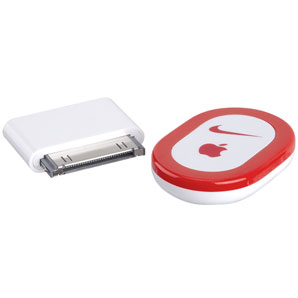
Nike+ iPod
  You simply calibrated your stride, and the sensor would accurately keep track of your pace, calories burned, and time elapsed, and displayed it for you to see on your Nano. When your workout was over, you could upload your workouts to Nike+  by syncing your Nano to your computer.

  Easy as that.

  It was a simple way to track results, and turn your workouts into a game. If you needed a little extra incentive to get out there and run, or run a little faster, Nike+ iPod was there to provide some motivation.

  It wasn't super high-tech by today's standards (this was released in 2006, after all), but Nike was still working out the kinks, and working towards a larger goal.

Nike+ Sportwatch GPS 
  In 2011, Nike got into the GPS watch business with their Nike+ Sportwatch GPS. Powered by TomTom, the Nike Sportwatch tracks your location, time, pace, distance, and calories burned.

  Just like with the Nike+ iPod, you sync the Sportwatch to your computer (via USB port, or wirelessly) to upload all your information to Nike Plus.
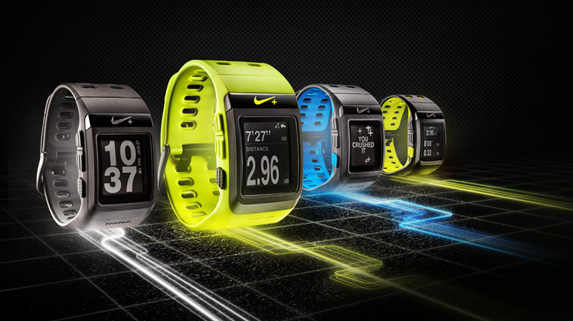
Nike+ Sportwatch GPS
  But with GPS in the game, you can review your routes online, and easily track your progress.

  On Nikeplus.com you're able to view mapped-out routes, detailed pace data (mile time splits), and changes in elevation of all the workouts you have done while wearing the Sportwatch. The accuracy of your pace is also improved since you no longer are relying on a calibrated sensor.

  Now, as an avid runner, I love the Sportwatch. I believe it has made me run faster, farther, and more often. And the watch isn't bad looking either. Many times, GPS watches are big and bulky, and you never want to wear them. But the Nike+ GPS Sportwatch has a nice design -- not to mention fun colors! 

Nike FuelBand
The first FuelBand -- or life monitoring bracelets from Star Wars?
  Since February of 2012, the FuelBand has been a hot commodity on Nike shelves.

  During the first few months of being on the market, getting your hands on a FuelBand was a tough task. After that initial launch craze, the FuelBand is now easier to come by.

  So what exactly is the Nike FuelBand? Let's start with the obvious: it's cool. Who doesn't want to wear a digital wristband, that lights up with 20 LED lights and a matrix display?

  To be honest, when I first saw the FuelBand, I immediately thought of Star Wars and the Ewok Adventure movies from my childhood. In my eyes, those life monitor bracelets were the first FuelBands.

  The FuelBand is meant to be worn throughout the day. No matter if you're working out or not. The digital bracelet tracks your physical activity and movement on a daily basis.

  It tracks: Fuel points earned, calories burned, steps taken, and also serves as a watch.

My all-time high -- as of Summer 2012.
  Now, what are Fuel points? Unlike calories, which are dependent on many factors, Fuel points are a unique unit to measure activity that is equal for every person.

  For example, if a 135-pound person, and a 190-pound person, both walk for 20 minutes, the 190-pound person will burn more calories, based on their size alone; but they will earn the same amount of Fuel points.

  That's what makes the FuelBand unique. Nike has created a way for everyone, no matter size, age, or gender, to be able to compete and compare their daily activity.

  Fuel points have no correlation to calories burned. This allows for fair competition between friends, colleagues, family members, and teammates. Who can earn the most Fuel points per day?

  The FuelBand measures how much you move. Period.

Or how much your arm moves.
  My only complaint about the FuelBand, is that it only registers movement when the arm you're wearing it on moves. Obviously, when you walk or run, your arms naturally move in unison with your legs.

  But say you're on a stair-machine, riding a bike, or doing yoga -- the FuelBand will not register any movement, even though you are clearly moving.

Mid-day Fuel check.
  The FuelBand comes in Small, Medium, or Large sizes. And also has removable spacers to give the band a better fit to your wrist.

  In a perfect world (or maybe the next release), there would be a way to also wear it on your ankle (when doing lower body cardio), or be able to tell the FuelBand you're doing a core body workout.

  I know many of us partake in yoga, pilates, spin, bike rides, workouts on the stair-stepper -- activities where your arm isn't vigorously moving. So this is something that needs to be addressed for future usage.

  My second complaint is that there seems to be no value for intensity. Running and walking for an hour gets you roughly the same amount of Fuel points.

  And similarly, I wore my FuelBand for an hour and 15 minute long shooting (basketball) workout, and got more points than I did when I played pickup basketball for the same amount of time. Standing in one spot and shooting is drastically less intense than playing full court basketball. The FuelBand should reflect that.

  Like the iPod sensor and the Sportwatch, the FuelBand, easily syncs to your computer. It uses the same account on Nikeplus.com, and you're able to track your daily progress in one place. That is where you're also able personalize your FuelBand and set your daily Fuel goal.

  At the end of each day, plug the FuelBand into your computer and watch your results pop up in front of you (or wirelessly, via an app). Syncing to a computer also recharges the FuelBand (it usually lasts three or four days without recharging, and only needs about 20-30 minutes to fully recharge).

The Payoff
  The FuelBand doesn't lie. If you've sat at your desk, or in front of the TV for too long, the FuelBand will tell you that it's time to move. It won't literally tell you. On several occasions, I've been enjoying an easy morning, only to check my FuelBand and see a measly 200 Fuel points. That means it's time to go!

  Also, on one or two occasions, I've found myself doing jumping jacks at 11 o'clock at night because I'm a few hundred points short of my Fuel goal. The FuelBand will get you moving, that's for sure.

  It's fun because it makes being active, and moving, a game. We all love competing, so whether it's competing against your previous best, or against your best friend, the FuelBand will get you moving!

  In our society, where we seem to need a little extra push to get active, I think the FuelBand is an excellent motivator, and actually, a reality check as well!

  If you don't need motivation to move, maybe the FuelBand isn't for you. But if you're active, and want to track your results, or seek some extra competition (or you're inactive, and trying to move those legs a little more), then I think the FuelBand is a great investment ($149).


  (Two side notes: 1) If you're deciding between the GPS Sportwatch, and a FuelBand, and you're a runner, go with the Sportwatch, hands down. Having the GPS capabilities is an incredible tool for runners. And the Nike Plus software is an added bonus! 2) It is not recommended to swim or shower with your FuelBand on. It is water resistant, not water proof.)

LINKS:

Wednesday, March 14, 2012

LEMO Foundation

LEMO Foundation

  I've made the importance of athletics in shaping my life no secret. Without basketball, my life would be on a vastly different course. I wouldn't be living in Europe; seeing its sights, experiencing its cultures, and playing the game I love, all while getting paid to do it.

  My road here has had many twists and turns. Maybe without just one of those twists, my journey would have led me to a different destination.

  Everything, for me, started with a solid foundation. My parents, my schooling, and my coaches and mentors, all helped me along the way. But what if I didn't have that foundation? Or what if I was missing one key piece? Then what? Would I have earned a Division I scholarship, leading to a career as a professional overseas?

  I've always thought that every kid should have the opportunities I have been lucky enough to have, no matter their background, and no matter where they grow up.

  A longtime friend of mine, Allison Magner, has recently gotten involved with the development and growth of a non-profit organization based in the Bay Area. LEMO Foundation is exactly the kind of community that would have come in handy, had my foundation developed cracks in it as a teenager.

  The founders of LEMO, Ali and David Taufoou, wanted their organization to be like no other: based on a family atmosphere. Not just a place where kids could receive academic tutoring, or only athletic coaching.

LEMO Playmakers!
  LEMO focuses on the development of kids (or playmakers, as they call them) as people, as students, AND as athletes. They want 'to empower high school students to strive for greatness and to become responsible, compassionate leaders.' 

  They help develop the skills necessary to become a successful student: organizational, time management, and study skills. SAT preparation is also provided, along with NCAA Clearing House guidance (a must if you want to compete at the collegiate level). 

  LEMO provides a family atmosphere that serves as a safety net for kids if their home-life doesn't provide the support they need. As mentors, earning the trust of, and showing commitment to each and every kid, is essential.

  Obviously the athletic training is what brings it all together. Sport is the common denominator for the playmakers at LEMO, and the motivator for many kids throughout the US. By using that interest in sport, and commitment to becoming a better athlete, LEMO (and organizations like it) has the platform to develop the leaders of the future. Athletically, LEMO promotes all sports, but specialties lie mostly in volleyball and football at this time.

The Foundry
  Maybe the most important thing, is that LEMO provides ONE place where all this can happen.  Every facet of LEMO is operated at The Foundry. Whether it's for a workout, study hall, a tutoring session, or practice, the kids at LEMO rely on the cream of the crop facility for everything. 

  Gym time and access to academic facilities can always a stumbling block when developing organizations like LEMO. Matt Krebs has been generous enough to partner with LEMO to allow The Foundry to serve as LEMO Headquarters.

  As part of their mission statement, and vision, the LEMO Foundation will continue to search for ways to "strongly focus on and help guide the spiritual, mental, and physical aspects of each individual that we serve - Liahona 'the Compass' of LeMo. Success is defined differently for each individual, but LeMo offers every avenue for our youth to reach that path according to their specific goals - Motu 'the Rock' of LeMo."

  LEMO might not be for everyone. The commitment has to be there from the playmakers themselves, and not just in one area. Just because you're involved with a great organization, doesn't mean you no longer have to work. The coaches and mentors will not pull anyone along.

  Surely there are organizations like LEMO all over the country. But from my experience it's difficult to weed through the countless after-school programs that may have various motivations. To me, these organizations should have one thing in mind: put the kids' best interests first -- no matter what.

Fellowship at LEMO
  What's amazing about LEMO is that the kids don't pay a thing. Through sponsorships, donations, and volunteers, playmakers are provided with an incredible opportunity without having to take out a small loan to do so.

  The LEMO roster stands at 22 right now; there are 22 playmakers. However, the foundation is looking to progress and grow, so that more kids can reap the benefits of their organization. In order for that to happen, word needs to spread, and more generous hearts need to be found!

  Regardless of their outcome, reaching the collegiate level (or beyond) or not, kids' involvement in a community like LEMO will only be beneficial to their (and OUR) futures. If kids are a part of something, if they have adults/mentors who care for, and who are invested in them, they can achieve anything. 

  Everyone deserves to have the opportunity to be the best they can be -- in all aspects of life -- and the LEMO Foundation is helping kids in the Bay Area do just that.

  For more information on how to become involved, in any capacity, with LEMO, please check out their website here.


Monday, February 6, 2012

My Time

Jumper vs. La Roche.

  Basketball's a team sport, yes. And having unselfish, team players will always be the centerpiece of a successful team.

  Every once in a while, you need to put the focus back on yourself. When your team is struggling, it's very easy to start pointing fingers; to get caught up in what you feel your teammates are doing (or aren't doing), what plays your coach is calling (or isn't calling), and what calls the refs are making (or aren't making).

  But at the end of the day, there is only one person you have complete control over, and that's yourself.

  My family has a series of favorite family sayings. I'm sure you know the ones. They've been repeated so many times, that you forget where they originated. One of those sayings comes from my Papa (at least I think it started with him!): 'take care of yourself, and it's a full-time job'.

  In other words, stop worrying about everyone else, and take care of you.

  It might not be the same context as he used it, but I think I can hear Papa telling me right now: 'don't worry about your teammates, don't worry about your coach, don't worry about the referees, don't worry about your opponent. Only you control how aggressive you are, how hard you're playing, and what kind of mentality you bring to the court every day.'

Help defense, or something.
  Like I said before, basketball is a team sport. It's one of the things I love most about it. Working together with your teammates towards a common goal. One person can't win a game by herself, and one person can't lose a game by herself. It takes a collective effort either way.

  If I wanted to play an individual sport, and only be concerned with myself all the time, I would have played tennis! But I love being a part of a team. It's a special atmosphere, and that's what has always drawn me to the game.

  Given that, what I sometimes have a hard time with, is finding that balance between a team mentality and individual mentality. I naturally am a 'team first' kind of player. Always have been. Throughout the years, I have discovered it is one of my greatest strengths, and it can be my greatest weakness on the court as well.

  I facilitate, instead of attack. I run the play, instead of making the play. I defer to my teammates, instead of leading the way.

MJ
  This week,the focus shifts back to me.

  In high school, our coach had us write individual goals before every game. And that is something I've done off and on throughout my career in Europe. I haven't done it in a while, but I think now is a perfect time to break out the game goals this season. It simplifies the game.

  What exactly do you want to focus on? I try to be as specific as I can. Sometimes I even break the game down into quarters. I remember reading Michael Jordan's Rare Air years ago where he simplified scoring 32 points a game. It's easy: eight, eight, eight, eight. Only to MJ, I guess.

  So we're shifting mentalities. Not to being selfish, but to getting the job done. And with the shift, I'm hoping to turn the season around. Cause what I have been doing isn't working. My team has lost four straight games, and I have been less-than-stellar on the court. Looking forward to a great week of practice, and
getting back on the right track!


...fitting song for me right now below.

Pin It

Wednesday, February 1, 2012

To Do: 2012


  I guess I've shared 'personal' things on my blog before, but putting your goals and aspirations out into the world, for everyone to see, is a little more daunting. A little more intimidating. Cause if you don't follow though and accomplish them, you look a little foolish!

  But I think that's also how you get things done too. You tell everyone who's willing to listen, what it is you plan on doing. And that right there, is sometimes motivation enough to keep you working -- keep you plugging along. Fear of failing is a powerful thing. When I've put my name next something, or said I'm going to do something, chances are, it's going to get done.

  I don't know about you, but I don't want to have to come up with excuses as to why I didn't follow through with 'such-and-such', so I might as well just do it, right (hmmm 'Just Do It')?!?

  And that's exactly what my blog has been, and that's exactly what posting my goals and resolutions for 2012 is about. Giving me that extra push. That extra motivation to get things done.

  A few things I have a hard time making 'measurable'. So I'm still working on my 'to do' list for 2012:

NEW YEARS RESOLUTIONS AND GOALS 2012

IMMEDIATE:
 -PERSONAL TRAINING CERTIFICATION -- decide if it's for me, and WHICH cert. to get. Then start working towards it. Certified by summer.
 -WORK ON RESUME & CONNECTIONS AT LEAST ONCE A WEEK
 -CONTINUE TO BLOG 3+ TIMES A WEEK
 -CONTINUE TO EAT AS CLEAN AS I CAN, & CONTINUE TO EDUCATE MYSELF ON FOOD SYSTEM
 -TAKE MORE CHANCES. PUT SELF 'OUT THERE' MORE -- How do you measure that?
 -FORMULATE GAME PLAN FOR THE SUMMER -- Summer plans if I play another season in Europe, or not.
 -DECIDE WHETHER OR NOT I WILL PLAY NEXT SEASON????

SUMMER:
 -RUN MY SECOND HALF-MARATHON -- Anyone want to join, or have done one that's fun? June thru August.
 -VACATION: 1) SOMEPLACE SUNNY (Hawaii, Caribbean....) 2) NYC
 -TAKE A CLASS AND LEARN SOMETHING NEW (COOKING, MASSAGE, OR???) -- Any suggestions?
 -DRIVE HIGHWAY 101 - OREGON COAST TO CALIFORNIA -- If not this summer, sometime soon. Have heard it's an amazing drive. Anyone done it??

  There's my to do list! Have a good Wednesday! 

  And a quote for the day:
“To give anything less than your best is to sacrifice the gift" – Steve Prefontaine


Wednesday, January 11, 2012

Setting Goals and Bettering Ourselves

You gotta put in the work to achieve ANYTHING!

  Resolutions and the setting of new goals go hand in hand with the start of a new year. I, for one, have never been much of a New Year's Resolution setter.

  Matter of fact, I don't think I've ever consciously made a resolution at the beginning of a new year. Sure, I've set plenty of goals for myself over the years, but never a 'New Year's Resolution'.

  For whatever reason, this year I'm contemplating actually jotting a few down. (Or am I too late? Seeing as were already a few weeks into 2012!) It dawned on me, that I haven't consciously set out to achieve one particular thing in quite some time: haven't written it down, and really set my mind to it.

  And when you think about it, that's exactly how we make ourselves better. You consciously put your mind towards achieving a goal, and you formulate a plan on exactly how you're going to do it. We're all works in progress, and bettering myself and my quality of life, is something that has grown to be a priority for me.

  There's one thing, though, that I don't like about New Year's Resolutions: Why do we wait for a new year to try to better ourselves?

  Maybe we should make monthly goals. Those might be easier to stick to, and easier to evaluate. After all, isn't one of the more-amusing things about setting New Year's Resolutions is how quickly they are broken?

  Anyways, onto some resolutions.

Set Up for Success
  So if I'm going to make some resolutions, I want to set myself up to be successful -- to follow through with them. It takes some honesty and self-evaluation. What do you want to change about your life? What do you want to pursue?

  Remember, not every goal and resolution has to be a huge epiphany. They can be light-hearted and smaller-scale too. But it's the deeper ones that probably will be the most difficult to achieve, and in-turn, have the most payoff.

  The most important thing when setting goals, is to make them manageable. You have to have a clear vision of what exactly you are trying to achieve. The more-specific, the better.

  The days of saying, 'I want to be healthier' or 'I want a better job' are over. What EXACTLY does that mean? Being healthier and getting a better job have different meanings for everyone. What does it mean, and what does it look like to YOU?

A Goal Pyramid
  Probably the most-productive way to setting long term goals and resolutions is to make a goal pyramid.

Top Level
  At the top of that pyramid is your very specific, very detailed goal. Define your goal. Make it measurable. Give it a time limit. And make it realistic. (Nothing like biting off too much, and immediately making things seem impossible.)

  As we all know, achieving a goal is difficult. A lot of times, we have to do things that are unpleasant and uncomfortable in order to reach that goal. It's during those unpleasant times we can lose our motivation. If achieving our goals were easy, we'd all be perfect human-beings though, wouldn't we?

  Somehow, in order to provide ourselves with the motivation, we have to form an attachment to our goal. What will reaching my goal make me feel like? What does it feel like in my mind when I reach my goal? Why is it worth it?

  We can accomplish anything if we feel it is worth it, and we feel it is achievable. Our reasons are the source for our motivation.

  I think forming this emotional attachment is the most important aspect of reaching our goals. Isn't the inability to stay motivated the biggest excuse used when goals AREN'T achieved? Someone else's motivations or reasons won't help you reach YOUR goals. It's within you.

  So we ask ourselves: how will my life be better when this goal is attained?

  That's what will keep you going. Outside motivations might help in the interim, but it's what is within (your reasons; why you want your goal) that will keep you on track. 

Second and Third Level
  The second level of the pyramid is the road map to achieving your goal. What are the more-immediate steps, or goals, to achieving our ultimate goal at the top of the pyramid? What can you do today?

  Essentially, they are a series of smaller-scaled goals.

  You can break your pyramid down into monthly, weekly, and daily goals. Our daily goals will help us achieve our weekly goals, and our weekly goals will help us achieve our monthly goals, and so on.

  Shorter-term goals are easier to evaluate, and are easier to hold ourselves accountable to. The HUGE goal may seem overwhelming, and too difficult, but when broken down into a series of smaller goals, it's made to seem more-achievable. And that's what this is all about. We want to set ourselves up for success.
  
"One may walk over the highest mountain one step at a time." – John Wanamaker

Tell it to the World
  Once our goals are set, and our pyramid is made, tell people about your goals! More than likely, it will help us stick to our guns -- be accountable. When you tell someone what you want to achieve, you'll probably be less-likely to throw in the towel. And if they're important to you, more often than not, they will offer support to you along the way.

  Finally, it becomes about action! It's about work ethic, and doing our work on a daily basis to reach our goals. It's common-knowledge that it takes 21 days to create a new habit. It doesn't happen overnight, so we can't expect immediate change. It's a long process. 

Breaking Through Negative Thoughts
  While action is at the forefront of goal achievement, our minds have a tendency to get in the way too, can't they? We must learn to deal with, and manage negative thoughts. Changing our mindset goes hand in hand with modifying our behavior. We have to train our brain. How can we respond to negative thoughts and behaviors with things that are positive and reaffirming?
  
  When negative thoughts creep into our minds, it's then we need to go back, and re-read our reasons. Remind ourselves of our motivations! Why are these difficult/uncomfortable times worth it? What did we want to feel like, again?

  Another way to turn a negative into a positive is to provide yourself with incentives. Reward yourself! When you reach a weekly or monthly goal, give yourself a pat on the back. (not just a mental pat on the back, but an actual reward for yourself!) Create reaffirming rewards for reaching your smaller-step-goals. Positive reinforcement helps in the journey.

  Resolutions and goals are very achievable, but it's a difficult journey, no doubt. The key is motivation! We have to believe in ourselves, and continually remind ourselves why our goals are important to us along the way.

  How many of you all set New Year's Resolutions? Or do you set goals for yourself on a regular basis?

  I'm going to give my New Year's Resolutions some serious thought, and I'll let you know what they are in the coming weeks!


  LINKS: