Monday, March 5, 2012

What the Body Says, Goes

2010-2011 season in Sweden.

  It's like it knew I was talking about it, and wanted to let me know EXACTLY who was in charge...

  On Friday I wrote about how I typically go about making my decision on whether I will play another basketball season abroad as a pro.

  Atop that list, is a heavy dependence on how my body feels, and if I feel I am healthy enough to play another physically demanding season.

  As an athlete, you're always going to have aches and pain, and bumps and bruises. But you quickly learn to decipher one from the other. What you can play through, and what needs more attention. There's an enormous difference between playing hurt and playing injured.

Playing Injured vs. Playing Hurt
  Playing injured is never a smart idea, in my opinion. An injury, of any kind, demands immediate attention, and requires you to take a break to let your body heal. On the other hand, I think everyone has played hurt at one point or another. You wake up with a stiff back, or your foot doesn't feel quite right. So you warm-up a little bit more-gingerly, and before you know it, you're feeling normal.

NCAA Tourney -- Elite 8 versus Oklahoma.
  As your career progresses (at least this has been my experience), your body develops its habitual injuries. They're the things that you always have to keep in mind, and be aware of.

  They've probably been nagging you off and on for years. But when it comes down to it, they're the things that always seem to be the culprit when it comes to keeping you off the court.

My Constant: My Back
  For some basketball players, it might be their knees. Since my college days, it's always been my back. Nine times out of 10, if I'm on the sideline, it's going to be because of my back.

  I had surgery on it when I was 20 because of herniated discs. It was a scary thing. Lots and lots of back pain, and leg numbness. Not normal for a 20 year old, is it? But thankfully, I felt immediate relief after the surgery, and slowly made my way back to the court.

  Dealing with my back has been a learning experience. I've learned a lot about what my body can and cannot do. Things that help my body excel, and the things that drag me down. I am very cautious about trying out new exercises or movements that I feel might expose by back, and cause any injury.

  I think because of the precautions I take, and the extra exercises I do (lots of stretching and core-strengthening), I have been able to keep my back relatively healthy during my career as a professional.

This season vs. Le Havre.
  But sometimes you can't help it. Things happen on the court -- you're bound to tweak it every once in a while. And that's exactly what happened with me over weekend. I felt a slight twinge in practice on Thursday, got treatment on Friday, and thought I'd be ready to go for our game on Saturday night (March 3rd). My body had other ideas however. And that's where you have listen to what it is saying.

Your Body is Boss
  Your mind can think one way, but your body might have a whole different plan. Sad to say, but you can't will your body to being able to play.

  It's a sobering thing, as an athlete, to have your body fail you. You can work all you want to prepare, but sometimes it's just not in the cards for you to be out on the court.

NCAA Tourney vs. North Carolina
  In my younger days, I might have tried to give it a go, and struggled though a painfully (in more ways than one) bad game. I've been there before, but I know better now.

  While I love basketball with all my heart, I realize it is a game, and pain is there for a reason. Not being able to play freely (injured) is no fun. In fact it's down right miserable, and that's one thing I will never do again.

  So I had to sit out our game versus Pleyber-Christ. It's always difficult to be on the sidelines, watching your team. You feel a little helpless. So all you can do is cheer your teammates on, and hope for the best. But sometimes you just have to listen to your body, and let things rest.

  Thanks for the reminder, body (not that I needed it)! You indeed DO call the shots! (by the way, I'm feeling better -- should be back on the court in a couple days!)

                Pin It

Friday, March 2, 2012

Decisions, Decisions

Playing in Poland.

  Every Spring, about this time, my anxiety level rises to its yearly-high. Summer is quickly approaching, and my basketball season starts coming to a close. I'm sure you're wondering, what's exactly to be anxious about?

  The end of a season marks the end of another contract. And with the end of a contract comes decision time. Do I play another basketball season in Europe? And if so, where? It's the case where one question leads to another. And then another, depending on how you answer each preceding question.

  Decision time, it seems, is coming earlier and earlier each year. It used to be that I didn't even think about the following season until I was in the midst of my summer/off-season. I would play it by ear. See what opportunities arose, both in the US and in Europe, and go from there. But more-recently, I have found that teams are making inquiries about the next season earlier than they have in the past. Or maybe, it is me that is wanting an answer earlier and earlier every year?

Love my summers!
  On the one hand, it's great to have your destination for the upcoming season in the books. You can enjoy your summer, and not worry 'will I have a team to play for?' as the off-season progresses. Call it job security. You know exactly where you will be come September, so you're able to focus on your workouts, and enjoy spending time with the family and friends you miss-out on seeing seven or eight months out of the year.

  But if you're wanting to see all possible opportunities, both on the court and off, you want to try to delay Decision Day as much as you can. The further you get into the off-season, the more teams have contacted you, giving you more on-the-court possibilities to choose from. While you're fielding inquiries from potential teams in Europe, it also gives you the opportunity to put out feelers into the 'real' world, and see what the working world has to offer.

Beautiful -- Dunkerque.
  Networking and navigating the US job-market is a difficult thing to do while in Europe. The time change (I'm nine hours ahead of my home timezone!) makes direct contact a difficult feat. It's something you really have to be committed to. And relying on email isn't going to cut it. Taking into account the number of emails people receive each day, the likelihood that they want to answer your job-market questions becomes minuscule. So networking becomes far-easier when you're on US soil.

  Are these excuses? Maybe so. Maybe I just need to put forth more effort.

  One thing I can say without hesitation, is that I've always had a difficult time turning down a good contract. If it's a good opportunity/location, the money makes sense, and you still love to play the game, how can you say no? Especially when you have nothing else lined up (as in, nothing solid waiting for you when you return home to the US). I've never thought that was good business to turn down a job. Maybe I'm too cautious that way.
Great teammates -- Sweden.

   So how exactly do I go about making that yearly decision of whether to play another season?

  First and foremost, am I healthy? As a professional athlete, your body is your money-maker. And if you aren't able to cut it on a consistent basis, it might be time to find a new profession.

  Secondly, do I still love what I am doing? If you wake up in the morning, and you dread going to practice, or you no longer have the passion to put in the extra work, chances are you aren't
going to enjoy yourself as much as you should be.

  These are the two major questions I ask myself before I make any sort of decision. There are other factors that affect my choice as well, such as potential teammates, location of team, previous experiences, and so on. But health and passion for the game, will always remain the two deciding factors.

Germany.
  In all likelihood, you're not going to find something that tops the profession I have right now. I have to say it's a pretty great gig. But it isn't forever either. So when does it become the time to start writing a new chapter?

  Some people have their mid-life crises, or quarter-life crises. I, on the other hand, like to have my annual life crises. :) One thing that eases my mind is reminding myself that there is NO wrong decision. Whatever I choose, I will be successful at it, and I will be happy. But with professional sports, it's something that you want to be 100% sure about. When you're done, you're done. There's usually no going back once you've called it quits (unless your name is Brett Favre). So you need to be sure. And the contrary is true as well. You don't want to play a season too long, and not have your heart in it.

Fun experiences abroad -- Sweden.
  For nine years I have chosen to play 'one more season'. Maybe I should make it a nice round number, and go for season 10. What do you think?


Pin It

Wednesday, February 29, 2012

Reclaiming Our Food Supply

 
  Let's rewind the clock five years. Now-President Obama was on the campaign trail vying to become the Democratic candidate. While making speech after speech, and meeting thousands of people across America, he vowed as President, to strive to: "let folks know when their food is genetically modified, because Americans have a right to know what they're buying." I could be wrong, but I think the majority of us agree with that statement. However, fast forward to the present, and we're still talking about the same issue. So what gives?

  This, by no means, is meant to be an assault on our president. But unfortunately, it's clear he made that statement before he discovered exactly who has a say in how our government is run. It's to show that we can have all the good intentions in the world, but our system is backwards.

  Our food supply is controlled by politics, and unfortunately, we have little-to-no-say in what happens. Through lobbyists and campaign contributions, corporations such as Walmart, Archer Daniels Midland, Tyson Foods, Monsanto, Cargill, and Kraft Foods have planted themselves front and center in the battle for control over what ends up on our plates. That stranglehold has wreaked havoc on the environment, our health, farmers, workers, and our future (follow related posts/links below for more information on GMOs and their effects).

  It seems easy enough: 93% of Americans have said they want GMO foods labeled (while it's estimated that 80% of processed foods in US stores contain GMOs), so what's the hold up? Put money aside, and do what's best for the people, right?

  But what we're seeing is Capitalism at it's best (or worst?). "Nearly all of human food production, seeds, food processing and sales, is run by a handful of for-profit firms which, like any capitalist enterprise, function to maximize profit and gain ever-greater market share and control."

  I'm no business major, but I guess that's called an oligopoly, or a near-monopoly:
  • Four corporations, led by Walmart, control more than half of grocery sales. Walmart alone gets more than one quarter of every grocery dollar spent in the US.
  • Three companies -- Monsanto, DuPont and Syngenta -- own 47 percent of the world's seeds. And they own 65 percent of the global proprietary maize market.
  • Nearly every major commodity -- wheat, corn, soy -- is controlled by just four corporations.
  • More than 90 percent of soybean seeds, and 80 percent of corn seeds used in the United States are sold by one company: Monsanto.
  Since 1996, the US acreage in GMO soybeans has grown from 7 to 94 percent, with GMO corn skyrocketing from 1 to 88 percent of cultivation. A trend began in 1996 in the US, and not for the better.

  A study released in September by the D.C.-based watchdog group Food & Water Watch reported that between 1999 and 2009, roughly $547 million was spent on lobbying and campaign contributions to ease regulatory oversight and prevent labeling of genetically engineered crops.

  There are so many issues, and so many question-marks; so where do we start? How do we effect change?

  One step is to continue to push for GMO food labels. If we can identify foods in the grocery store, it becomes that-much-easier for us to avoid. The Just Label It Campaign is nearing 1 million signatures. 17 states also have potential legislation in the works for GMO labeling. So progress is being made in that regard.

  However there are more levels in the system that need changing. Labeling is a start, but revamping our food supply system is what's really needed.

  Pressuring Congress to end agribusiness subsidies, and begin spending our money on sustainable healthy foods and farming. "Pass a 2012 Farm Bill that reinvests public money in an economically diversified, ecologically sustainable and more locally-oriented food system." There are dozens of steps that can be made, and these are just a few. Read more about those ideas, and get a clearer understanding of the big picture here.

  Another example of how the line between big Agriculture and politics has been blurred: FDA senior adviser, Michael Taylor (who was appointed by President Obama in 2009) formerly served as vice-president of Monsanto. Sign the petition asking President Obama to 'cease FDA ties to Monsanto.'

  Most European Union countries have managed to keep GMOs out of their grocery stores thus far. And when modified foods do wind up on store shelves, you able to easily identify them because of labeling. It seems Europeans are winning the battle to keep control of their food supply. Monsanto has halted sales of modified maize in France recently, and BASF announced it would move its GM development plant from Europe to the US.

  When government is involved, I'm sure we all think there are bigger fish to fry (economy, ongoing war, etc). But really, is there anything bigger than our health, and the health of our future generations?

  As food policy expert Michele Simon says, "Single-day actions here and there won't cut it when powerful food industry lobbyists are roaming the halls of Congress and state legislatures all over the nation every day of the year."

  We need to get involved, and start paying attention. Take control of our food system by reclaiming our  "land, our labor, and our economy from corporate monopolies." It's a big mountain to climb, but I think we can do it. I look at it this way, if you can affect just one person, you are doing your part!

  ~ Sabrina

Pin It


RELATED POSTS:
Do You Know What GMOs Are? 
The Effects of GMOs 
Dangers of Soy
Just Label It blog


LINKS:
Obama's GMO Food Labeling Promise
Michele Simon: Cracking the Politics of Food
Political Battle Over GMO Labels
GMO Foods

Big Food Must Go
Occupy Our Food Supply
Petition to Cease FDA ties to Monsanto
Just Label It

Monday, February 27, 2012

London: The Good, the Bad, and the In Between

Tower Bridge behind.

  Amazing, that in a little over two hours you can seemingly go from one universe to another.

  For me, riding the train through the Chunnel, to and from London, was the equivalent of going to another world. How can two places so close in geography be so different in culture and atmosphere?

  I guess when one of those places is one of the largest international cities in the world, you're bound to get an incredible experience not seen many other places. 

  Here are a few highlights (and the always unavoidable low-lights when traveling) from my two-plus days in London this weekend:

The Good:
    A look down onto the river from London Eye.
  • the view from London Eye -- even though it isn't cheap (almost £20, or $32), the ride on the giant ferris wheel is a must for everyone!
  • Tower Bridge -- loved the setting. The detail and the color is much different when you can see it in person! Very cool. 
  • Borough Market -- would love to have spent more time at the farmer's/food/everything market, and maybe had a quick meal. But we got there late in the day, when things were closing up. Reminded me a bit of Seattle's Pike's Place Market (with less fish).
    St. Katharine's Docks.
  • St. Katharine's Dock -- right off the Thames River, and under Tower Bridge. An area we sort of stumbled up upon, where we found the coolest Starbucks I've been to -- in an old gazebo-type building in the middle of the marina, and some beautiful (expensive!) yachts that were docked there.
  • Barclay's Cycle Hire -- we rented bikes for £1 per bike for 24 hours, and explored Hyde Park and Kensington Gardens by day, and rode back to Covent Garden from Tower of London by night (2.5 miles). A fun/different way to see and explore the city. Gave our tired legs a much-needed rest.
  • being in a International/Global city -- on any given street corner, store, or restaurant you can hear seemingly every language EXCEPT English. Also you're able to find any type of food you may have a craving for. 
  • stumbling upon cool parts of town you didn't necessarily intend on finding (St. Katharine's Docks, Borough Market and surrounding area, Kensington Palace Gardens - one of the most expensive residential streets in the world).
  • Tower of London -- visited twice the castle twice. Amazing views all around the grounds. Didn't go in, however. Would have cost another £20!
    Sunset on the Thames. London Bridge.
  • Covent Garden  -- another lively district, where you can find fruit and vegetable stands, along with various other types of foods and goods to shop for.
  • sunny weather! -- it's London, if the sun comes out, it's a good day. We had 2 straight days of sun.
  • happening to get to Buckingham Palace right as the changing of the guard was getting underway. Hoards and hoards of people gathered to watch and catch a glimpse. Made me wonder what it was like last Spring during the Royal Wedding.
  • Niketown London -- cause I enjoy anything Nike. 
    Buckingham Palace at the changing of the guard.
  • walking the Thames River at Sunset.
  • Big Ben & House of Parliament (Palace of Westminster) -- loved the detail you could see in the buildings, and hearing Big Ben gong. 
  • the Tube -- London Underground is easy to use--didn't get on the wrong train one time! And of course, 'Minding the Gap'.

The Bad:
    Big Ben, of course!
  • Pound to U.S. Dollar conversion -- buying anything, then converting how much you've spent to dollars, realizing you're grossly overpaying ($25 for an Italian pizza, $6 for a 1/2 pound of Starbucks coffee, etc..) 
  • being unable to explore the neighborhoods in Notting Hill and Kensington because you realize you need to ditch the previously-mentioned Barclay's bike rental bikes -- but not having a docking station anywhere in sight. We then found two different docking stations, that were not yet operational! One hour and several miles later, we finally got rid of the bikes! 
  • having tired/swollen legs & ankles (the life of a tourist!).
  • lots of construction -- understandable because London is preparing for the Summer Olympics (the Underground, Plazas, and various monuments were all being worked on). 
  • not knowing enough (ANYTHING?) about British & Royal history -- it's hard to fully get a grasp on the big picture when you have no foundation to start from. 
  • not seeing the Queen.
Tower Bridge and Tower of London.
The Ugly:
  • being in an English-speaking country and understanding, at best, 1 or 2 words out of every 7 spoken by a Brit. After constantly saying what?, at some point you just nod, and pretend to understand. I guess 'British' and 'American' really ARE different languages!
  • breaking your camera on the first day, and having your phone (which served as my back up camera) die by 6 pm each evening.
  • not quite trusting the 'look right' or 'look left' signs painted on the crosswalks, and standing on the corner, looking five times, both ways, before crossing the street.
    The cool Starbucks. Of course we went in for a drink!

  • being unsure if the British tip in restaurants -- they don't everywhere else in Europe! Yikes (we later found out that they do tip)!
  Anytime you travel, you'll have some great, and not-so-great moments. Thankfully the great moments were far more-frequent than the latter!

  Those are some of the moments that stuck out for me the most about London!

  All in all, I had a great time getting a little taste of the capital of England, and am hoping to make it back in the near future.

  Enjoy the pictures and video!


 Panorama view of London from London Eye.

They're nice to help us outsiders cross the street without getting hit.
Me with a few friends at Buckingham Palace.
End of the Changing of the Guard ceremony.
Required London Underground picture.
Looking up Westminster Abbey.
Westminster Abbey.
Big Ben and the House of Parliament.
Top of the House of Parliament.
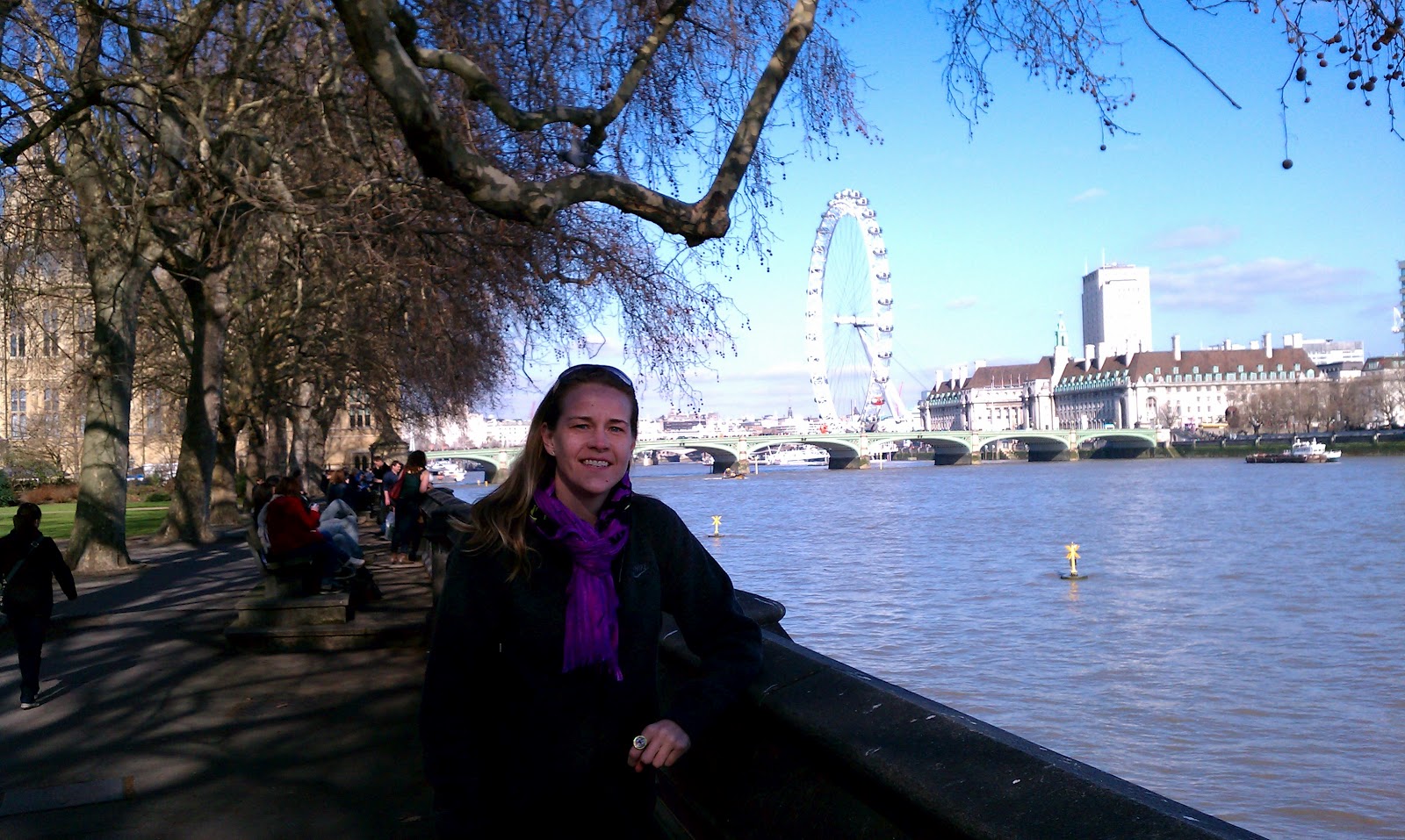
Thames River, with London Eye behind.
Looking up Big Ben.
Big Ben and House of Parliament from the bridge.
V and I heading up the London Eye!
Almost to the top!
Still inside London Eye.
Tower Bridge.
The infamous bike!
Kensington Gardens.
Found the Peter Pan statue!
Kensington Gardens.
V telling me how tired she is. ;)
Kensington Palace Gardens.
Riding bikes in Notting Hill. Taken while riding my bike!
Finally found a docking station to get rid of that bad boy.
Niketown London. A must for this Portland girl.
Covent Garden. A big bowl of Paella.
V's excited. Or tired. One of the two. In Covent Garden.
Minding the Gap on the Tube.
Tower of London.
Tower of London.
Sunset at Tower of London.
V ready for round two on the bikes!