Tweet
Championships in Europe work differently than they do in the States. Every professional league I've played in while in Europe has operated using 'promotion and relegation' at the end of each season.
This is the process where the two strongest teams (based on season record) move up to the next highest league for the following season (if there is a higher league); and the two weakest teams move down to the lower league.
It's an interesting system that ensures every game counts, and has equal importance. For you futbol fans out there, it's the same process that is used in the English Premiership, or any other soccer league around the world.
Jumper versus La Roche.
My team, DMBC Dunkerque, was coming off a horrible 40-point road loss last weekend. Our record going into our game on Saturday was 3-5, and we were about to play Reims, a team at the bottom of the standings, at home. In my eyes, Saturday was a must-win game. Since we had already given a few games away earlier in the season, we couldn't afford anymore slip ups. Another loss would send us even further in the wrong direction.
While it might be a little early to start worrying about relegation, I don't think you should lose sight of reality either. It's always important to get wins where you absolutely should, and especially when they're at home! In our league, I have found that on any given Saturday, any one team can beat any other. No one is untouchable. Just like there is no team you can look past. Our game against Reims was one that we absolutely should have. But we needed to make sure that we followed through, and got the win!
Reims started off strong. They put us in a hole early in the game by knocking down open 3s, and scoring inside with their big girl (who was 6'7" by they way). We trailed 24-12 at the end of the first quarter. But this time there was no panic. We regrouped, and we continued to play. We picked up the intensity of our defense and crawled back into the game. By the halftime break, we had taken a seven point lead.
Versus Leon Tregor.
The third quarter started and we immediately blew the game open. We rattled off nearly 20 straight points, and never looked back. It was a great feeling to finish the game on the bench with smile on my face. We hadn't had a win like that all season, so hopefully we can do that a few more times before the season is over.
So we're sitting at 4-5 now, with four games to play until our season's midway point (the season is going SO fast!). For me, it's always a goal to be on a a winning team. I'm hoping we can eventually get our record above .500, and keep it there. That way relegation wouldn't even be a possibility!
Jelenia Gora - Poland. 2006-2007.
In my eight prior seasons in Europe, relegation has never been a topic of conversation (or maybe it WAS a topic of conversation, and I just didn't understand when they were talking about it!!). The year I played in Poland, it was my team's first season in PLKK (the top division in Poland). Since they had moved up the year prior, it was that much more important for us to finish in the top part of the standings, and remain in the first league.
There is one experience I've never had while playing in Europe, and one experience that I never WANT to have. And that is being on a team that has been relegated to the lower division. I don't plan on having it happen this year. and it's a distinction I never plan on putting on my resume!
Tweet
Holidays are funny. When you're in school, you don't really care what the reason, you're just happy to get a day off. And while I can't say I know from experience, I'm ASSUMING it's the same with work (there really are no holidays with basketball).
Whatever the occasion, you're just happy not to have to set the alarm clock.
So I guess I'm saying maybe we've lost sight of what the holiday is really about. Or maybe I've just lost sight?!?
As this week passed, I knew Veterans Day was approaching in the U.S. And here in France, they were preparing for a 'closed day' (November 11th) as well. Usually I don't pay much attention to the holidays while I'm abroad (maybe that's where I've gone wrong!). But since it was falling on the same day as our Veterans Day, I was curious to know what exactly November 11th was! So with that in mind, I set out to regain a little perspective.
Here in France, and much of Europe, November 11th is Remembrance Day/Jour du Souvenir (or Armistice Day). It's a memorial day to recall the official end of World War I on that day in 1918. Hostilities formally ended at the '11th hour, on the 11th day, of the 11th month' with the signing of the Armistice between the Allies and Germany.
Just as in the U.S., red 'remembrance poppies' are used to commemorate soldiers who have died in war. In France however, the blue cornflower (bleuet) is used instead of the poppy. Armistice Day is one of the most important military celebrations in France since it was a major French victory, and since they lost so many men in battle.
In the U.S., Veterans Day used to be known as Armistice Day as well. It was renamed in 1954 after the Korean War ended to honor all military veterans.
Red Remembrance Poppy.
So as it turns out, the U.S. and most of Europe are celebrating and remembering their veterans today. I'm glad I took a little extra time today to appreciate what November 11th actually means. It makes the the time off, and the day a little more special. However you choose do it, take some time to thank a Veteran today!
Tweet
We've all woken up with sore muscles at some point in our lives.
Maybe we got a little carried away at the gym, pulled a few too many weeds in the yard, played in an intense basketball game, or maybe we just took too long of a break from doing much of anything!
Regardless of how they happen, sore muscles are a part of the 'game'. But when it does happen, how can we speed up the recovery process?
For me, rolling out of bed is something like a roll call: How's the back? How are the feet? How's the ankle? And so on. Aches and pains are a given in my world. But it's learning how to manage the sore muscles, and recover more-quickly, that enables me to get back out there, and go just as hard the next day.
Train hard, recover hard.
Recovering vs. Resting
Some might think 'recovering' is just doing nothing. No, that's called resting, and I'll talk about that later.
Why is it necessary to recover? Think of 'exercise as the architect, and recovery as the builder.' You do damage to your muscles, and break them down when you exercise, and recovery is where the progress is made.
After a workout, your body needs to repair itself. Whether you're preparing for your next training session, or just trying to feel better, recovery is an essential part of training.
Your body repairs itself when blood vessels bring oxygen to your muscle tissue, all the while removing built-up lactic acid. Too much lactic acid can cause your muscles to function poorly and will often lead to fatigue.
Stretching is crucial!
A little soreness is always a good feeling, I think, at least (but I might be crazy). It lets me know that my body is really working, and I'm working hard.
But too much soreness? Now, that's just uncomfortable. So here are some things we can do to make those sore muscles feel better a little bit quicker!
Recovery Methods
First and foremost, stretching is key! In my younger days, I'd always laugh at the older (ahem, more experienced) players stretching after practice. Now, I can't imagine not stretching. I always try to stretch after a workout or practice, even if it's just for five minutes.
Everyone can stretch. You don't need anything special, just a little commitment to your body!
Secondly, you need to eat! They call it the 'Golden Hour' after exercising: eating within an hour after your training session. It's important to have a little carbohydrate, and a little protein. You also need to replenish amino acids and electrolytes (potassium and magnesium) after training as you lose electrolytes when you sweat.
This may all sound a bit confusing, so let's make it easy: I like to have a whey (not soy!!) protein shake after a tough workout, and mix it with fresh fruit like strawberries, blueberries, and a banana. But if you want to make it even easier, stick with a banana, a TBSP of peanut butter, and a little Gatorade.
The first two methods, everyone can do. You just a little discipline and diligence. It will help you get the most out of your workout, and help your body feel better in the long run!
The following methods require a little extra effort, and sometimes, a few extra dollars:
Ahhhhh.
Who doesn't love a massage every so often? Sure, they can be a little painful at times, but afterwards you feel like a million bucks! There are countless types of massage practices, but they all have the same effects.
Massage increases blood flow, which helps repair muscle damage, releases lactic acid, and also increases flexibility and range of motion in joints. Massage obviously also loosens tight muscles and helps to dissipate soreness more quickly. Massage has also been shown to make the body less susceptible to injury (tight, rigid and fatigued muscles can make injury a more common occurrence).
Massage, however, can get expensive. That's the one drawback. There is a method of self-massage using a foam roller. You may have seen people using these at the gym, and wondered what they were doing. I know I've had a few odd looks shot my way!
All in all, using a foam roller has the same benefits as massage, without the price tag that comes along with it. Just as with massage, using a foam roller will hurt at times, but the benefits pay off! If you don't know what a foam roller is, or don't know how to use one, here's an example video:
As I've spent more time in Europe, I've gotten more and more used to using sauna/steam room as a recovery method. For some reason, I don't find it as popular in the US. The benefits of sauna are similar to massage, and go far beyond just relaxation.
Sauna sessions will increase circulation, deeply relax the muscles, can shorten recovery times from workouts (by repairing muscles aches and strains more quickly, and clearing out built up lactic acid in muscles). Again, sometimes it's difficult to gain access to a sauna or steam room, but check and see if your gym has one. If they do, don't be afraid to try it out! Just don't forget to drink lots of water!
The lovely ice bath.
The last method of recovery, is actually the FIRST method I grew accustomed to using. In college after long, difficult practices, or runs on the track, I would bite the bullet and get in the ice bath.
Yes, it's pure torture for 10 or 15 minutes, but I promise you'll feel the benefits right away! It immediately reduces swelling and inflammation, flushes out lactic acid out of fatigued muscles, and helps prevent injury. You won't regret it, at least once you get out of the tub!
Obviously, nothing can compare to rest and relaxation. You have to get your rest (SLEEP) in order for your body to repair itself. Listen to your body! If it's sore, it's telling you it needs a little extra attention, and a little more rest.
The more rigorous your workouts, the more you'll need to actively engage in these recovery methods. They'll help you bounce back more quickly, and they'll help you get more out of your training.
I have used all of these methods at various times, and have found them to be very beneficial. Some of the methods are clearly more enjoyable than others. But you know what they say: 'No pain, no gain'.
Tweet
Been to Portland? Then you've seen the growing phenomenon of mobile kitchens/lunch wagons/snack shacks/whatever you want to call them known as food carts. Sure, they weren't started in Portland, but the Rose City seems to be taking food carts to the extreme.
It's hard to know for sure how many there are exactly. I've seen the number range from 500-600. The carts are generally open for business during the lunchtime hours, and are set up in parking lots, sidewalks, and sometimes city parks.
Most of the pods (groups of food carts) can be found downtown, making it a convenient option for office workers, students, tourists, or anyone looking for a quick, delicious, inexpensive lunch.
What makes the food carts so unique is that they offer a combination of quality, diversity, and value. You can find any sort of 'ethnic' food you desire: Thai, Bosnian, Czech, Ethiopian, Mexican, etc; or the classics: Pizza, burgers, sandwiches, and waffles. There are also carts that satisfy the vegetarian or vegan appetites (this is Portland after all).
All these options can usually be found for $5-7. Not bad for a tasty lunchtime meal.
A pod of carts downtown.
I can say I've only managed to try three or four food carts, but I've always loved what I've had. I don't find myself downtown during lunch very often, otherwise that number would be much higher!
One cart deserves a special shout-out: Koi Fusion. I had been hearing about the Korean/Mexican fusion cart for sometime, but had never had the opportunity to try it until this summer. Think Korean BBQ (marinated meats, veggies, and sauces) 'fused' into Mexican forms (tacos, quesadillas, burritos).
I tried the Bulgogi Taco, and was in food-heaven right away. I'm looking forward to visiting again while I'm home for Christmas! Koi does just fine without me adding to the hype, but it's just that good!
Koi Fusion truck.
There are websites to help keep food cart frequenters up-to-date on locations, menus, closures, and openings. Food Carts Portland provides a guide on where to find the carts, and what to eat once you get there. It contains a listing of carts, a map, a search feature, and categories by cuisine types and specific locations. But don't expect to find reviews there, they want you to decide for yourself!
Whenever you're from a certain place, it's easy to ignore the things that make it famous. I hardly knew that Portland had become a 'foodie destination'. But people tell me this is true. So I'm probably not alone in thinking that the popularity of food carts in the city will help that reputation continue to grow.
And if you haven't had the pleasure of visiting the Rose City yet, here's another reason to do so. Just make sure you try out a cart or two (or 10)!
Tweet
Usually I reserve Mondays for game recaps. Here's the shortest recap known to man: we lost by 40 points (ok, it was actually 38) on Saturday. I'll spare you (and me!) the ugly details, and leave it at that.
So instead of recapping the game, I'll recap our road trip the south of France.
I was a little unsure how this whole road trip was going to go. We were set to leave Thursday after practice, and drive through the night. That scared me. I don't know about you, but sleeping on a bus is not something I normally do. In fact, usually the only place I can sleep a wink, is in the comforts of my own bed. I was re-assured over and over again that this would be a 'sleeper' bus where you would be able to lay down. Still, I was a bit skeptical.
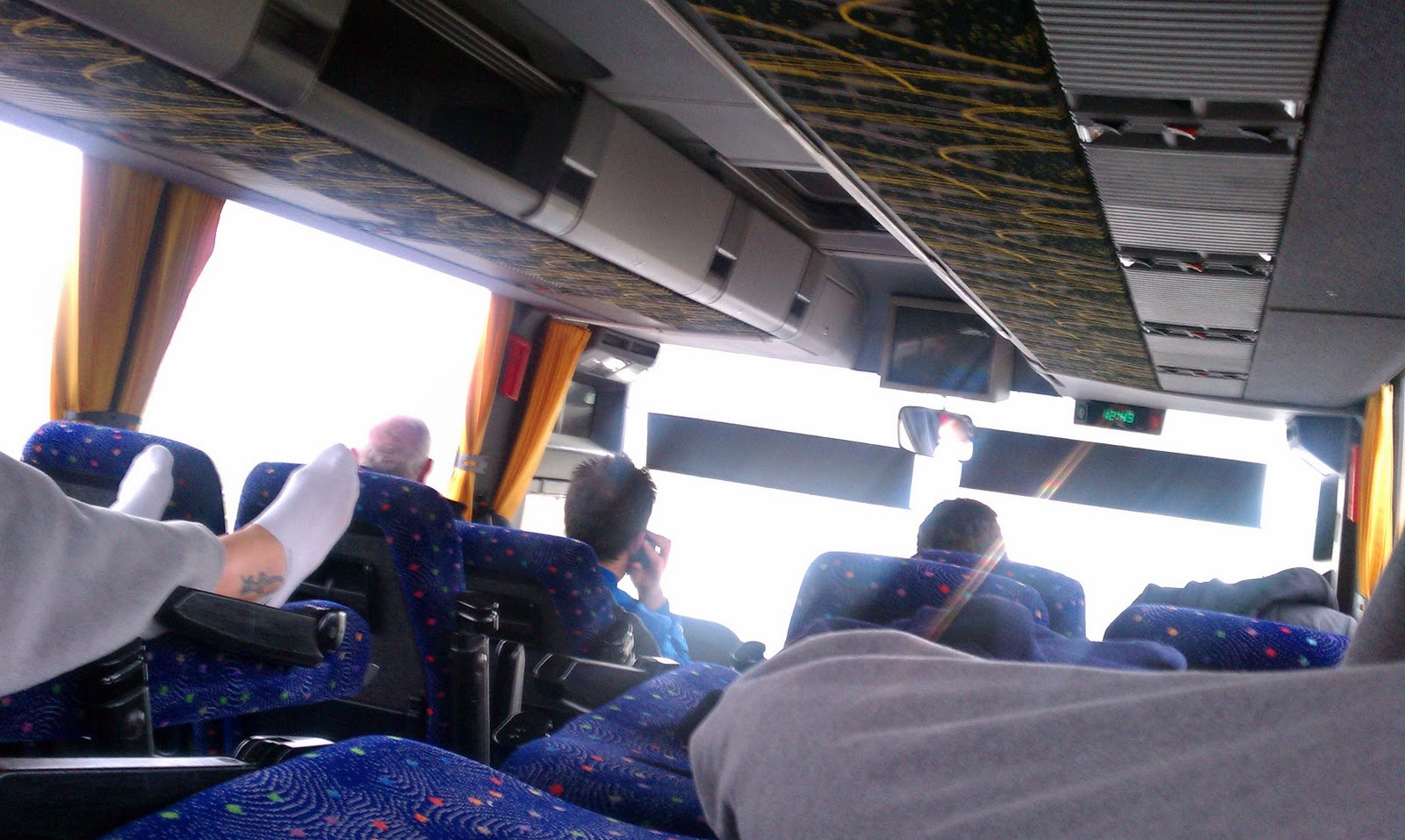
My perspective on the glorious sleeper bus.
I was prepped for the long ride: laptop, iPods, Android all charged to keep me entertained. Books to read, and paper to write on. I also came prepared to sleep: with a padded sleeping bag (thanks V!), pillows, and blankets. I got my spot on the bus, and settled in.
Thankfully, no one had misled me about the bus. You could in fact lay down. The bus was like any other charter bus. But you were able to fold the chairs down, essentially making bunk-beds throughout the bus. I chose to be on a bottom bunk because I figured it'd be a little more stable, and darker than the top bunk would be.
View of the front of the bus. Top bunk.
Once I got used to the shifting and movement of being on the road, I did actually fall asleep! Now don't get me wrong, it wasn't the greatest sleep I've ever had. But it was a great feeling to open my eyes, and have the morning light shining in (meaning I had slept through the night, and most of the long trip!).
Our destination, Perpignan, is very close to the Spanish border. So that is exactly where my team wanted to head once we reached the south Friday afternoon. Why Spain, you ask??? Cheap(er) alcohol, cigarettes, candy, and chocolate. My best guess as to why it's cheaper in Spain: there are fewer taxes on those items versus in France.
Rows and rows of candy.
After enjoying a tasty Spanish buffet for lunch, my teammates headed to the supermercado to find their bargains! I didn't want to lug anything back to Dunkerque (and nothing was really THAT enticing), so I can't say I bought anything myself. Though I have to say, there was some chocolate and candy that looked amazingly good
Rows and rows of alcohol.
Once my team finished their shopping, our time in Figueres, Spain was up. The bus was finally headed in the direction of Perpignan! 16+ hours after leaving Dunkerque, we finally made it to our destination. We had the evening to do as we pleased until dinner (no practice), so I was excited to see a little of the city.
Entrance into the city center.
A few teammates and I went into the city center to do some shopping, and see what Perpignan had to offer. I immediately loved what I saw. We were in France (obviously), but Perpignan also had a strong Spanish and Italian influence, which I thought was awesome. The wall surrounding the city center was something I loved to see (and reminded me of my first European city, Como), and gave the area a unique feel.
My teammates and I sat outside at a cafe, where they ALL enjoyed a Coke, while I had an espresso...ha! We wanted to make the best of our limited time in the city, so we tried to get the lay of the land as we sat. Honestly, I just like to walk the cobblestone roads and get a feel for the city. I think that's the best way to see a new area, and the most-enjoyable way to spend a few free hours.
Perpignan.
A couple hours is hardly enough time to fully be able to appreciate a city (I haven't even mentioned the weather, and being so close to the Mediterranean!). But I saw just enough of Perpignan to know that if I ever got the chance to go back, I would.
Perpignan.
Even with the disaster on the court (our game), and the 30+ hours spent on the bus, I came back from Perpignan with a good feeling about the things I experienced over the weekend!
Tweet
Cold and windy day on the beach means it was just as busy as usual! The North Sea was jammed packed with kites and kite surfers in front of my apartment this afternoon. So I wanted to get outside and take some video for you all to see. As you can hear, it was super windy! I had some brilliant commentary to go along with the video, but the wind over-powered my voice. :)
I tried to follow some individual surfers in the second video, so you could see what they do. A little bit hard to see, but you get the idea!!
Tweet
30 hours on a bus for a 40 minute basketball game. The glamorous life of a professional basketball player, huh?
My team plays in a city called Perpignan on Saturday night. Perpignan is roughly 700 miles (or 1100 kilometers) from Dunkerque. Anyway you slice it, that's a long time on a bus. We left Thursday night at 10, will travel though the night, and will arrive in Perpignan sometime this afternoon (Friday).
Needless to say, I'm loading my bag up with books, music, movies, my laptop, and pen and paper (for when my laptop dies). But I'm hoping to pass most the time sleeping! If all else fails, the road trip will give me a good opportunity to brainstorm for upcoming blogs!
Hope you have a great weekend! Yours will *probably* be more productive than mine. Unless you consider traveling 1,400 miles in a couple days an accomplishment. I'll let you know how it goes!
The route from Dunkerque (blue) to Perpignan (red).
So now, what can we do to identify them in the grocery store and more importantly, avoid them?
GMOs & Their Effects
But first here's a QUICK recap: GMOs are Genetically Modified Organisms. They are organisms (seeds, plants, animals) whose genetic material has been altered from its natural state. DNA molecules are combined with different sources to create a new set of genes, and essentially a new organism.
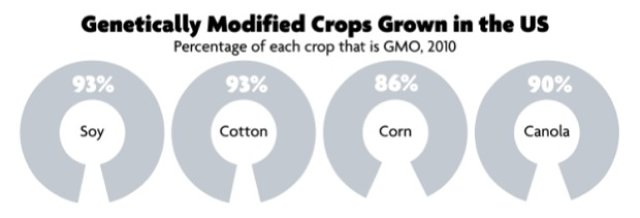
The US food supply is full of GMOs, but they are most prevalent in corn and soy crops. Unfortunately for us, corn and soy is found in virtually everything these days!
And while the effects on our health (rise in infertility, obesity, Diabetes, Autism, Parkinson's, asthma, cancer, etc rates) cannot yet be directly linked to GMOs, they haven't been proven safe either.
In 2009, the American Academy of Environmental Medicine publicly condemned GMOs in our food supply. Saying GMOs posed 'a serious health risk.' They also asked the U.S. government to implement an immediate moratorium on all GMO foods, and urged physicians to prescribe non-GMO diets.
GMOs have infiltrated our food supply!
Personally speaking, I'm not going to wait for the government to tell me they're unsafe. The long term consequences of GMOs on our health and environment have NOT been adequately researched. Since learning how potentially harmful GMOs are to our health and environment, I quickly became determined to avoid them at all costs. So what do we look for?
How Do We Identify Genetically Modified Foods?
Since GMO foods are not labeled in the US (like they are required to be in over 40 countries worldwide), identifying them can be somewhat difficult. But it's not impossible. All it takes is a little diligence on the part of the consumer!
Non-GMO Project seal.
Keep in mind that roughly 80% of packaged foods in the U.S. contain GMO ingredients.
First and foremost, when buying processed/packaged goods, look for the Non-GMO Project verified seal. Products with this seal have undergone independent third-party testing to ensure they have been made to best avoid GMO ingredients. So this is a helpful tool.
The second thing you must do when buying processed foods is look at the ingredients list! Avoid at-risk ingredients (the big 4): corn, soybean, canola, and cottonseed products. Okay, this is nearly impossible, so let's move onto step three.
Pick & Choose When to Buy Organic -- the Dirty Dozen & Clean 15
When buying fruits and vegetables it's a whole different ballgame. Federal researchers found that certain types of organic produce can reduce the amount of toxins we consume on a daily basis by as much as 80%!
The "Dirty Dozen" is a list of produce that contain the highest amount of chemicals, and should ALWAYS be bought organically.
When 'conventionally' grown (non-organic, with chemicals), these fruits and vegetables tested positive for at least 47 different chemicals, with some testing positive for as many as 67. Those numbers are frightening if you ask me!
Do we really want those pesticides in our bodies? Here are the Dirty Dozen: Apples, Celery, Peaches, Strawberries, Domestic blueberries, Nectarines, Sweet bell peppers. Spinach, Kale and Collard greens, Cherries, Potatoes, Imported grapes, and Lettuce.
I know buying Organic produce can get expensive. So there's also a "Clean 15" that lists fruits and vegetables that have little to no traces of pesticides when grown 'conventionally' (non-organically).
By keeping these two lists in mind, you can avoid a great deal of harmful and unnecessary chemicals! In my opinion, it's best to have a "No Chemical Policy." Since when is it okay to consume chemicals?
Just Label It!
Demand GMOs Be Labeled
The last thing we, as consumers can do, is continue to push our government to label GMO foods. We need to make these harmful foods more-easily identifiable in the grocery store!
As I mentioned before, over 40 countries worldwide label modified foods, so why is the US so far behind?
The Center for Food Safety recently started the Just Label It campaign. The CFS has petitioned the FDA demanding it require the labeling of modified foods. Go sign it! This link will send your comment/request to the FDA and President Obama.
While it may be difficult, and somewhat time-consuming, I encourage you to be diligent on your own, and pay attention to what is in your food! A chemical is never a good thing to put in our bodies.
After all, we only get one of them! Be mindful of how we are treating it!
I went to the Dunkerque Beer and Wine Festival this weekend, and had a fun experience trying a raw oyster for the first time. Here's the video...it scared me to death! :) Note when they tell me I have a 1 in 2 chance of getting sick! Thanks to Bruno for the video, V for the translation, & Sebastien for the oyster!
Tweet **Originally appeared on SLAM Online November 2nd, 2011 in what was originally called DubBall** Hey women's hoops fans! I can't tell you how excited I am to be involved with DubBall, and how thrilled I am that women's basketball (and its players) will be getting a platform it so much deserves.
I've been a gym rat/hoopaholic since I was about eight years old. Matter of fact, I can't remember a time in my life where basketball wasn't front and center. So I'm excited to be sharing my experiences with people who love the game just as much as I do.
I'm in the midst of my ninth season as a professional player in Europe. I've been all over the map in those nine seasons: Italy (two seasons), Portugal, Poland, Bosnia, Sweden (two seasons), Germany, and now France.
I've seen a lot in my time in Europe, both on the court and off, and my hope it to share some of those experiences with you all! It's an adjustment for an American to move to Europe (both to play, and to live). Some of the quirks that make Europe special you learn to love, and some you never get accustomed to!
My time overseas has been an awesome adventure, and I look forward to re-telling some of my tales.
Before making the jump to Europe, I played at the University of Colorado from 1999-2003. In my four years as a CU Buff, we made three NCAA appearances; advancing to one Sweet 16 (22=003), and one Elite 8 (2002). I graduated in 2003 with a degree in psychology.
Originally, I'm from Lake Oswego, Oregon (Lakeridge High School); and still make that my home in the off season. Though, I do find time to make frequent visits to Colorado as well!
I invite you to hop on board with me this season, I'll try to make it a fun ride! Looking forward to hearing from you readers, and would love to answer any questions you might have.